ig·nore verb —refuse to take notice of or acknowledge; disregard intentionally.
fail to consider (something significant)
If you’re like most people you probably deny you ignore problems. But it’s more common that we think.
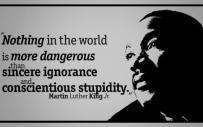
In fact, ignoring a problem is a coping mechanism we’ve used since cave-man days. Often it’s easier to ignore a problem instead of trying to solve a problem. If we deem there is no problem then there is no worry about solving a problem that we deem doesn’t even exist!
Personally, being ignorant (a variant of the verb ignore) is a survival mechanism. If facing our problem is not directly linked to survival we make it a lower (or no) priority. Once survival needs are met, it’s easy to ignore other problems. With this mantra, our life seems to become easier…. But this is a fallacy. Ignored problems never go away. What was a small issue becomes a great problem when it is ignored over time.
There are dozens of business examples failing when leaders ignore problems. When the business leaders fail to critically examine policies, process, the market, customers, and trends they ignore potentials problems.
Ignoring problems (or failing to try to proactively find and solve problems) is a failure of leadership.
During the 1990’s my friends were in the 1-hour photo business. Things were profitable for more than 10 years. Business was good. It was easier to ignore future problems. In their business world nothing was changing. Yes, there were some stirrings of electronic digital cameras in a distant horizon, but that technology was expensive. In 1995 a good digital camera cost between $5,000 – $6,000. There was nothing to worry about. Customers always wanted the cheaper and more convenient 1-hour service. My friends ignored the issue… After all, they had a government contract for film development. Ignorance was bliss—that is until digital cameras oversold film cameras in 2003. My friends went bankrupt.
Blockbuster video opened first in Dallas Texas in 1985. Nine years later Viacom bought Blockbuster for an unprecedented $8.4 billion. Blockbuster ignored Netflix as a competition. Blockbuster ignored the change in the video market from stores to subscription home delivery. Blockbuster executives literally laughed aloud at a 2002 offer to acquire Netflix. Blockbuster ignores kiosk rental service beginning in 2003 (Redbox). Blockbuster ignored the customer complaints of late fees for 14 years. In September 2010 Blockbuster went bankrupt. Ignoring the changing market and customer needs was expensive.
Circuit City was a 60 year old electronic and appliance behemoth and went belly up because the executive leaders ignored basic problems.
After 120 years in business Kodak Eastman went bankrupt in 2013 because it ignored its core business. Kodak insisted it was in the “film” industry and ignored “digital imaging” as the new paradigm.
This is not unique to business. Government and police organizations litter the landscape with examples of failure due to the power of ignore.
A victim reports a sex crime. The police officer waits a few days to ‘check in’ to the allegations. Ignored and avoided, the victim went to the local news outlet to get answers. The Chief of Police is then explaining the lack of timely response by the officer and trying to avoid a public embarrassment. The officer is censured for ignoring the call for service.
A senior executive received damning information about the organization. The boss gave the executive a mandate to investigate and find the validity of the information. The executive delayed 2 months to beginning an investigation. The message is: Ignore a message long enough and it may go away. Conversely the thinking is: This issue isn’t serious enough to put energy into it. They ignored the seriousness of the allegations.
An agency chief bemoaned aloud that there was no accountability for his executive staff. He indicated there were no measurements to determine if the junior staffers were being effective. Eventually he decided there were no effective way to measure efficacy of staff work; so the problem went away. He ignored the real issue.
Months ago a senior executive administrator was asked a similar question: “What are the matrices or benchmarks associated with [a key position in the organization]? After the executive stopped laughing (yes, he literally laughed out loud), he said:
“There is no way to measure effectiveness in [that position]. There are no benchmarks or matrices.”
Essentially he said no problem exists, so we can ignore a problem we haven’t specified.
What are the differences between these responses? In substance, the officer, the senior executive, and the chief was ignoring or denying that problems exists. This is a leadership fail.
The reason business and government leaders ignore problems is because they fear change. Period. Dr. Robert Kriegel (Sacred Cows Make the Best Burgers) wrote that in 1996. News flash: 20 years later— NOTHING HAS CHANGED.
In 2016 John Kotter (author of That’s Not How We Do it Here) postulates organizations need disruption and stability to thrive. Management is about stability. Leadership is about disruption. There is no place to ignore issues. Leaders disrupt. Leaders need courage.
Organizationally blissful ignorance is sometimes the modus operandi. For managers and supervisors it’s easier to ignore problems rather than try to effect solutions. Maintaining the status quo is safer than working to solve an issue. The mantra seems to be
“If it ain’t broke, don’t fix it”
Dr. Kriegel says new mantra should be
Kriegel says we must face our fears and embrace whatever change we experience. There is no dodging the rapid change of society. Things change more quickly than it used to and the pressures can be intense.
The opposite of ignorance is not knowledge. The opposite of ignorance is courage. The solution to ignorance is to develop courage. We dispel ignorance by courageously asking questions and seeking answers. If we, as leaders, experience courage then our knowledge grows and our ignorance doesn’t have so much power.
We must have courage :
- To look at the unknown
- To ask questions that are uncomfortable
- To challenge the status quo
- To act when action is needed
- To be politically incorrect
- To “get it wrong”
- To see past the platitudes and seek causal issues
- To feel discomfort and move past it
Yes, there is a power to ignore…. But ignorance not a positive power.
Of course, your mileage may vary…
Dr. Jay


 We're All Just Tourists