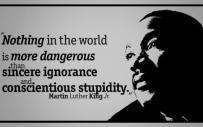
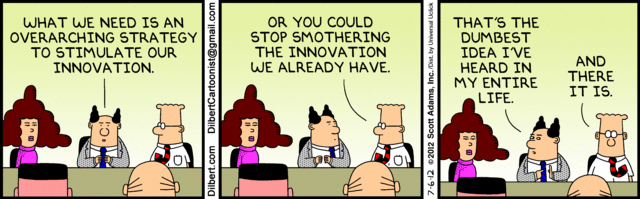
CIT Leadership Initiative Model

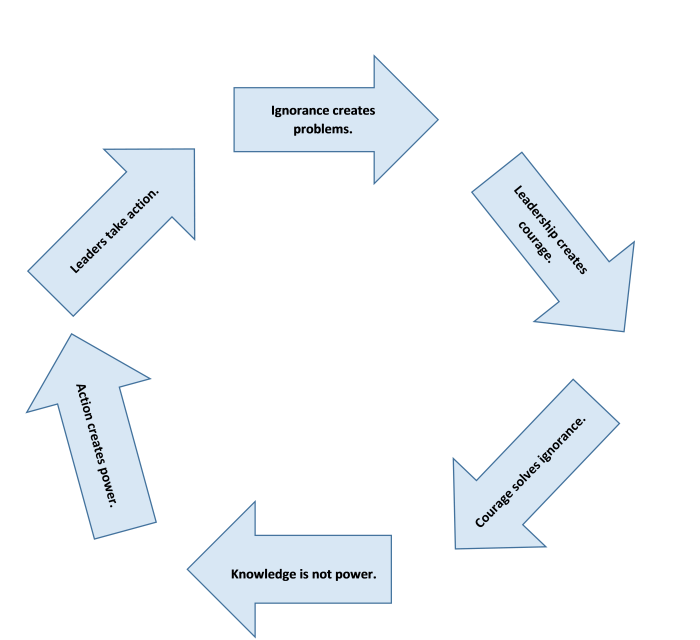
  • CITModelIgnorance creates a problem.


An issue or problem exists, but there is no long-term solution. There are Band-Aids applied… there is rhetoric… there are grumbling and grousing… The problem is ignored. The problem may be small and seem small for a while. But that same problem that seems small may grow or fester. An ignored problem does not go away. Labeling a problem other than a problem does not make it a “not” problem.

Look for problems. Never accept there is no room for improvement. Good may not be good enough.

Encourage criticism. LB NT… Liked best… next time…. 5 likes, 2 next times


  • Leadership creates courage.


Leadership, at its core, is action. Leaders have a bias for informed action. A leader finds the ‘problems’ and work to solve them. Usually this involves posing several courses of action and risks— The leader takes one course of action, adjust, refine, correct, & re-act. The care needs to be addressing the real problem… If it (whatever it is) doesn’t improve, ask different questions.

Which comes first? The courage or the leadership? Kind of like the chicken and egg question.

If you don’t like the answer, change the question.


  • Courage solves ignorance.


Courage is the opposite of ignorance. Looking at the problems, asking questions, not settling for status quo, seeking courses of action, taking action, re-evaluating, adjusting action, and paying attention will solve the ignorance issue. This is courage in action. Action is leadership. Leadership will solve ignorance.

There is a fine line between courage and stupidity. Know courage is in short supply. When you display courage you will rise to the top.

Ask for input. Your eyes are only yours. They have fresh eyes… use them too.


  • Knowledge is NOT power.


Sir Bacon Francis, in a book titled Religious Meditations, Of Heresies (1597) wrote “knowledge itself is power”. He was half right. Knowledge without action has little power. To know but not act is true heresy. Francis was commenting on the church and their lack of dogma transparency. In current days, knowledge is common. Almost every human knows how to lose those few last pounds… Eat right, exercise more, don’t eat just before bedtime… It’s not the knowing that makes a difference, it’s the action.

Going to training will NOT improve your CIT program. You must do some work. It’s you… not them.

Your circle of influence expands when you share your knowledge.


  • Action creates power.


There is no substitute for action. Education, knowledge, classes, more knowing… Nothing will outperform taking action. Being the greatest running theorist does not make you a great marathoner. Only running makes you a good marathoner. The universe does not like a vacuum. If there is no positive action, a plot of ground will become weed and vine filled. There is no garden without a gardener. The most knowledgeable gardener must act to get positive results.

Action isn’t a solo act. There are others, just don’t wait for ‘them’ to act. You take action first.

Specify the 3 next steps for your action. Then act. When that’s done, figure your next 3 steps… Then do those… Repeat…


  • Leaders take action.


Because there is no substitute for action, the leader acts. The leader creates personal and positional power by action. This action ensures the one who acts will be essential. Action does creates problems for those who do not act… particularly if they are in positional power posing as a “leader”.   Some positional “leaders” do not act… Action has risks. For instance, you could fail or you could make a mistake. Which leads the circle back to the leadership model where a problem was created by ignorance. The leader never finishes. They adjust, learn, find courage, and act.

Leaders are introspective and take responsibility for their action.

Leaders foster a culture of action (and mistakes). There are zero errors when there is no action.

The CIT Leadership Initiative is a non-profit corporation (503c) for the education and proliferation of CIT Training and community policing.  For further information contact CITLeadership@mail.com 

Of course, your mileage may vary

Dr Jay

I Am a CIT Evangelist

e·van·ge·list/əˈvanjələst/ noun

  • a person who seeks to convert others to the CIT thinking, especially by public exhortation and living the CIT principles.


“Evangelist” is a great ‘tag’ to start because every great idea begins with passionate and great thinking. Great ideas are pushed into being by, change agents or “evangelists”. Evangelists don’t just drink the Kool-Aid, they live it and truly believe in the innovation they espouse.

What separates true evangelists and change agents from the rest of the flock is the intangible fire they possess. Evangelists are willing to bet their political capital and careers on a new ‘disruptive’ process or idea. Evangelists will talk about their project or interests; not just to those interested, but to their colleagues during lunch, their friends when not working, and more.

Evangelists are very persuasive. They are absolutely essential to getting buy-in from the rest of the organization. They are also the ones to convert the first couple of flagship participants. If at least a percentage of your crisis intervention team does not consist of evangelists, the team has a good chance of failing.

Why? Because evangelists conduct themselves like mini-CEO’s. And that’s what you need at a time when roles and responsibilities are still in the process of being defined. You need go-getters, self-starters, and learn-as-you-go people who are willing to put on different hats rather than expect to delegate to an assistant.

Evangelists get their hands dirty. They are not just theorist—they are practitioners. They are willing to work, do, and try. They are willing to show a critical eye, but are also willing to find alternates instead of just criticize.

Only an evangelist can convince a crusty patrol veteran to try a small innovation in dealing with the mentally ill consumer.

Further, evangelists will help you to recruit other strong talent. The intensity of evangelists will probably scare off ho-hum bench-warmers and attract the A-team the big change initiative will need, especially in the formative months.

Years ago one of the men who helped form my world view taught me:

“Everything rises or falls on leadership. Everything.”

And I believed him. He was a true leadership “evangelist”. Dr. Lee Roberson (1909 – 2007), the founder and Chancellor of an alma mater, was fanatically about leadership. And as a result of his fervor, he impacted two generations of leaders.

I am a CIT evangelist. Join the crusade with me, won’t you?

Of course, your mileage may vary…

Dr. Jay

Synopsis and Analysis: Alien Boy Documentary

Alien Boy: The Life and Death of James Chasse

SYNOPSIS

Alien Boy is a non-preachy 2013 document which shines light onto the James Chasse police custody death.

The documentary is full of interviews, deposition videos, document reviews, and asks some hard question.  The documentary does not draw a conclusion, rather it lets the watcher decide what to believe.

Chasse was a severely mentally ill person who, by the mental professionals, was a ‘good example case’ for community care.  After years of work and training, he was living independently and doing fair. Unfortunately he stopped taking his medications; which is a part of the disease (schizophrenia), and didn’t take care of himself.  He appeared unkempt and homeless.  Just days before his death, one of his mental health workers tried to visit Chasse at his apartment (with a Portland Police officer), but Chasse ran when he saw the police.  He was mortally afraid of police; based on his mental illness and his prior police contact.

The mental health worker asked the responding officer (Officer Worthington) to “flag” Chasse as severely mental ill.  The hope was to notify other police officers that Chasse would not respond positively to police contact when he was off his medications.  The case worker asked any police who encounter Chasse to contact a case worker 24/7. The worker asked Officer Worthington to make a report of Chasse running from the contact.  The officer declined to write a report and declined to “flag” Chasse.

The fatal meeting with Portland Police began relatively innocuously.  A Portland Police officer (Chris Humphreys) thought he saw Chasse urinating outside in the bushes. Chasse ran when the police tried to contact him.  The officer chased and tackled Chasse.  The physical evidence and eyewitnesses show a full body football style tackle.  The Multnomah County jail video recorded Officer Humphreys describing the tackle as a football tackle.  Officer Humphreys weighs about 240 pounds, Chasse weighed 145 pounds.  Officer Humphreys told a different story under oath at the deposition.

Chasse was hit, kicked, Taser-ed, and struck numerous times by the responding police officers.  He lost consciousness and on-lookers thought he was dead.  Chasse was handcuffed and ‘checked out’ by a responding ambulance team.  The EMTs were not told about the kicks, hits, strikes, use of Taser, or the loss of consciousness.    A sergeant (Portland Police Sergeant Nice) advised that “Chasse was going to jail, if he checked out medically”.

The EMTs said Chasse’s blood pressure was in the normal range.  Sergeant Nice ordered Officer Humphreys to sign the medical release.  Humphreys transported Chasse to the jail, where the jail nurse declined to admit Chasse, due to his poor condition.  Humphreys decided to transport Chasse to the hospital (instead of calling for an ambulance)—Chasse was dead when he arrived at the hospital emergency room.

There were allegations that Chasse was on drugs, was a drug dealer, and had rock cocaine on his person.  None of the allegations were true.  Chasse had not been urinating in the bushes.

Based on the information provided to the Grand Jury, there were no criminal charges.

The Portland Police Bureau conducted an internal investigation from October 2006 – October 2009.  The result of the internal investigation was released to the public in October 2010.  The death occurred in September 2006. The internal investigation only found fault in an officer’s failure to tell responding EMT about the subject’s loss of consciousness, use of physical force, or Tasing.  The internal investigation does acknowledge the ‘take-down’ (as described by Humphreys at the deposition) is not trained by Portland Police.  The medical examiner found Chasse’s death was caused by blunt trauma in his chest, similar to being tackled.

Ultimately the internal investigation did not address the use of force, a lack of underlying valid core transaction, or another myriad of issues.  Essentially the documentary seems to show there is a systemic indifferent problem by police response when dealing with mentally ill persons.

The City of Portland and the AMS (ambulance service) avoided the civil trial by paying about $1.6 million to the Chasse family.  The City denied any wrong-doing and denied a police issue.  A city official said the police didn’t failed; policy failed.

The federal Department of Justice (DOJ) investigation was started by city leaders, but the Portland Police Bureau did not initially cooperate.  The DOJ did determine there is consistent pattern of civil violations by responding Portland Police officers when contacting mentally ill persons.

ANALYSIS:

The documentary was hard to watch.  It makes me ask challenging questions:

Is (police misconduct) an endemic problem in policing today?
Do de-humanizing and de-sensitization exist where I work?
Did systemic de-humanizing and de-sensitization become the norm in policing? How?
Are police responses nearly to the edge of criminal indifference?
Are there long-term solutions? Do we need them?  What are they?
The documentary does not try to find solutions.  I am sure there are no easy solutions.

There are two learning themes to address and hopefully addressing the themes give an ability to grow and learn.  The themes are de-humanizing and de-sensitization by police.  Here are the elements of both themes:

De-Humanizing         

Language

Actions

Beliefs

Enforcement

De-sensitization          

Exposure

Abnormative behavior

Allowed de-humanizing actions

Rewarded de-humanizing actions

De-Humanizing

Def: an act or behavior that undermines individuality.  Opposite of personification.  Tactic to deny compassion, moral response, and allows atrocity.  In the extreme it becomes the Holocaust or the Rwanda Genocide.

Language:

Language is one of the easiest ways to detect de-humanizing traits seeping into behavior.   Linguist and language specialist can detect family of origin, prejudice (even hidden), socio-economic levels, and much more by hearing normal conversations.  Police language is an easy metric for measuring levels of humanistic vs de-humanizing ideas.

One indicator of de-humanization is how police officers when refer to suspects. De-humanizing begins by using judgmental, non-human, anatomy part, or animalistic language. These are words such as:

Dirt bag, shit head
loser,
dick head, cunt, asshole,
bad guy,
douchebags,
scumbag,
doper,
scrote,
mope,
fuck-head, fuck-tard,
loser,
crackhead, tweaker,
crazies, 12-34,
nutbag,
bitch,
monkey, loon-toon,
illegals, transients,
or hundreds of names or monikers or identifiers.

This vocabulary indicate the underlying belief that subjects are non-human or less than a whole human.

Other de-humanizing language (without of conscious intent) indicates “us versus them” philosophy. At the core, “us vs. them” means ‘we (police) are good and right’ and ‘they (non-police) are bad or wrong’.  It further delineates the humans from the sub or non-humans.

Some of the language indicating de-humanizing people may be:

  • prey (criminals) vs predator (police)
  • happy hunting
  • thin blue line
  • warrior
  • sheep dog or other words.

Racism, xenophobia, misogyny, bigotry, lack of tolerance, civil right violations, declination of human rights and hate crime have its roots in de-humanization language.

Actions:

The most de-humanizing response are de-humanizing actions. This indicates the person being contact “isn’t important as a human being”.

Our actions speak so loud our words can’t be trusted.  Using this approach, the subject’s ability to conform to normal society makes them seem less than human.

Some actions indicating this de-humanizing belief is:

  • Failure to look at the person.
  • Using a ‘paternal’ communication approach in dealing with subjects.
  • Ignoring the obvious present issues (physical, economic, social, etc.).
  • Expecting a person who is mentally ill to respond as if there is no mental illness.
  • Minimize mental illness as a ‘real’ illness.
  • Minimize suffering or pain.
  • Blame the victim.
  • Lack of empathy  “handcuffs aren’t supposed to be comfortable” “shut up” “I didn’t ask you” “I don’t want your information” “you aren’t important”
  • Making fun, ridicule, mock, or deride the subjects with others.
  • Attempt to antagonize the subject to get a negative response therefore giving justification to respond with force.

Beliefs:

Beliefs are the most insidious component of de-humanizing.  If you ask a hundred police supervisors or officers:

“Do you believe subjects are sub-human?”

The answer is a resounding “No! We do not belief that. We believe in the sacredness of life.  We treat people as people”.  Unfortunately, language and actions betray beliefs.  Our true beliefs come from the way we talk and act.

Enforcement:

Police culture always overcomes police policy.  Policy is always carried out based on the paradigm of the current culture.  Ask yourself; “Is there is preponderance of enforcement leveled to a particular population?”  If the answer is ‘Yes’, does this mean the population is targeted by de-humanizing beliefs?  The answer is maybe. Usually this enforcement bias is not probably by design; bias is more usually by default.

Several police research studies show that enforcement only doesn’t solve community issues.  In spite of this knowledge many supervisors and officers enforce violations and laws differently to various population.  If a subject is well-dressed, well-spoken, affluent, or appears mainstream; there is less chance of enforcement action.  If a subject appears transient or mentally ill there may be more incidents of enforcement action.

Effective policing recognizes that 90% of the solutions are not ‘police’ solutions or ‘enforcement’ solutions.  Solutions that work are community or relationship or education or cooperation solutions.  Effective policing comes from so-called “community policing” or “MDT” (multi-discipline team) policing.

According to many studies of policing there are several prominent types of policing:

  1. Watchmen.  (The Crime Fighter) Emphasizing law and order.  Rules are codified by social, legal, and cultural grounds.
  2. Legalistic.  (The Law Enforcer) Emphasizing law enforcement and professionalism.  Effectiveness is measured by police numbers (arrests, citations, amount of drugs seized, subject contact, etc.)
  3. Service.  (The Social Agent) Emphasizes the functions of police work.  The question is “Why do we do what we do?” Sometimes referred to as “community policing”.
  4. Fluid. (The Hybrid) At any given time an officer may police by any type depending on the need, mood, temperament, or population faced.

De-sensitization

Def: a process to become less sensitive.  The process by making (someone) less likely to feel shock or distress at scenes of cruelty, violence, or suffering by overexposure… Diminished emotional responsiveness to a negative stimulus.  Systemic de-sensitization makes de-humanizing possible.

Exposure:  

Police officers are exposed to unimaginable suffering, cruelty, and violence.  The very nature of the job means an effective police officer must be hardened.  They must have some lack of sensitivity.  An effective response may be hard to maintain balance.  The difference between being sensitive to the right things at the right time is a razor’s edge.

Abnormative behavior:

Abnormal behavior becoming normal is nothing new.  Most criminals didn’t start with big crime; most became bolder and criminal acts became more serious.  Domestic violence often starts with lack of respect and de-humanizing language before moving to physical assault.

This is the true nature of de-sensitization.  In police training it is called socialization or ‘becoming a cop’.    Over time, police abnormative behavior becomes normative.  This callous phenomenon displays true police culture.  A ten year police veteran has a different point-of-view than a first year officer.  This is based on exposure of abnormative behavior and developed de-sensitivity.

Allowed de-humanizing action:

Without direct intervention things may go awry.  The landmark Stanford Prison Experiment (later a movie) was a study in perceived power and psychological effects leading to de-humanizing actions.  The de-humanizing actions were allowed and even expected.  This was ‘the way it was supposed to be’.

There is a perception in popular culture that police work (without gender) is a ‘macho’ profession.  There is a certain bravado required, according to the archetypes and Hollywood tropes.  We allow and permit de-humanizing actions and sometimes even encourage them.

Rewarded de-humanizing actions:

There is vast chasm between allowing and rewarding de-humanizing behavior.  However, when our police system does not chasten or correct unwanted behavior, this behavior is essentially being rewarded.  Police systems overtly celebrate or reward de-humanizing actions by promotions, primo assignments, medals, acknowledgment, or other kudos.   Over time this causes the system crumbles into de-humanization.

Rewarded de-humanizing actions is normal in popular movies and television.  Some examples may be:

Robo-Cop
Terminator series
The Expendables
Mission Impossible
The Departed
Training Day
Dirty Harry
Lethal Weapon
Black Mass
Sicario
The French Connection
End of Watch
Donnie Brasco
…. And the list goes on
As a society we have created a generation of movie watchers who are de-sensitized and prone to de-humanizing because exposure to popular culture.   This fantasy world, too often, seeps into the real world.

QUESTIONS TO PONDER

Q:  Is this (police misconduct) an endemic problem in policing today?

A:  The answer depends on who you ask.  Social critics say yes.  The agencies say no.

If a police agency says “Yes”, they open the organization for civil lawsuits, personnel action, and who else knows what is in that Pandora’s Box.   This risk-averse point of view leads to a culture of denial, an inability to self-censure, or ability to change or grow.  If there is no problem; then there is no solution needed.  Nothing to see here.

To find the answer if police misconduct exists, the leaders must examine the agency’s language, thoughts, and police actions.   Historically this examination is the function of federal investigations (Department of Justice/DOJ) when prompted by allegations of wrong-doing.  Sometimes the results lead to a consent decree settlement and becomes the catalyst to change police responses.

The feds have reached over 100 consent degrees in the past 10 years.  By these numbers, there is NOT an issue in policing.  There are almost 18,000 agencies (as of 2012) and there were less than 100 DOJ investigations initiated a year.  This is about ½ of 1% or scientifically noted as .0055.

Q:  Do de-humanizing and de-sensitization exist where I work?

A:  Again, it depends on who you ask.  If there is no problem, there is no solution needed.  It’s easier to deny an issue than solve one.

The progressive forward thinking leader acts pro-actively. Usually this leader may consider this is an issue and work to solve the issue before it becomes a cancer.

Q:  Did systemic de-humanizing and de-sensitization become the norm in policing? How?

A:   I think it is the norm.  However, to survive in the police field there will be some “numbing”.   This became the norm because police agencies have been given the response of responding to mental illness crisis without training or a ‘heads up’.

Society has changed the expectations for police responses.  Historically, police has assumed the role of “law enforcer”.   Today’s police are expected to be “law enforcer” and they are also expected to be responding “social workers”.  The career field was not prepared for these expectations.

The police response that worked in the 1990’s (and prior) do not work in today’s world.  Social media, instant connections, video capture, and popular culture that blurs reality/real life have impacted society’s expectation for police response.    An expected result will be to de-sensitize and de-humanize that which is not familiar.

Q:     Are police responses nearly to the edge of criminal indifference?

A:     The great majority police officers are not indifferent to the human suffering they see daily.  Most are compassionate and humbled by their law enforcement experience.  Criminal indifference becomes when the responding police officers have been given no tools or ways of dealing with the over-whelming stimulus.  Or conversely, police administrators have not recognized when the responding police are over-saturated and need assistance to remember their humanity.


SOLUTIONS

Executive actions:

Allow the possibility there is room for improvement
Create memo discouraging/prohibiting non-humanizing language when writing or acting as an officer
Stop rewarding de-humanizing behavior
Create a dialogue with community partners
Ask for positive examples from the community.  Reward those actions.
Be the example.
Hold self, supervisors, and staff to the example
Find the hiring components that support humanistic ideals and hire those people
Supervisors:

Stop using non-humanizing language.
Coach other to stop non-humanizing language
Look for positive language and recognize this behavior
Hold self-accountable for actions
Don’t turn a deaf ear.  Listen for and correct de-humanizing language.
Officers:

Practice humility. Check your ego
Remember we are a public servant organization
Find ability to create personal resiliency
Recognize humanity when it presents itself
Make a game with yourself to humanize subjects
 

This synopsis and analysis is the opinion of Officer Jay Irvin, PhD.  Jay is a Police Officer and Crisis Intervention Team (CIT).  Jay is a recycled behavior change therapist with an earned Doctorate in Human Behavior Psychology.  He’s a speaker and writer on leadership and organizational change.

Copyright 2017©

These opinions reflect Officer’s Irvin and may not reflect the city or police department belief.
It’s A New Day

I’ve been through the grinder in 2016.

2016 was a crap year.  I had a stroke. Got divorced (again). Lost a position I really wanted.  I had to re-structure my job (and life).  There was Cheeto elected as commander-in-chief…  Adios 2016 and good riddance.  Hello 2017… It’s a new day.

But this is life.  Life is hard.  Wear a cup.

So I’m re-calculating my next move… It hit me like a grumbling tummy after a Taco Bell run… I have to adjust. I have to do what I’ve been training so many managers to do.  I have to  manage change in my life.

If I don’t get the job I wanted (I didn’t)… If I have to live with post-stroke language issues (I do)… How will I manage my life and how will I positively change my life to make adjustments?

For the past 9 months I’ve been the CIT ‘go to guy’ for CIT deliverables.  I’ve written the policies, standard operating policies, and training.  I’ve delivered training.  I’ve participated in the international and regional CIT conferences.  I’ve been a consummate CIT guy.

CIT, for the uninitiated, stands for “Crisis Intervention Team“.  CIT programs have grown for the past 20 years to help communities and police officers respond more effectively to mental ill and other crises calls.

When I was writing a CIT article one of the CIT guys close to the program read it and said “Ya know the way you write it, there isn’t that much difference between CIT and good leadership”.  This is when the proverbial light bulb above my head popped on!   I’m a CIT expert AND a leadership expert.

I’m passionate about leadership, BUT I’m also passionate about helping police officers find more effective solutions when dealing with people who have mental illness.   It truly is a new day.

I’m adjusting this blog.  I’m moving to provide tools for CIT members, leaders, and practitioners.

I do want to provide value… But of course, your mileage may vary.

Dr Jay Irvin

Power of Ignore (Or Ignorance)

ig·nore  verb   —refuse to take notice of or acknowledge; disregard intentionally.

fail to consider (something significant)

If you’re like most people you probably deny you ignore problems. But it’s more common that we think.

martin

In fact, ignoring a problem is a coping mechanism we’ve used since cave-man days.   Often it’s easier to ignore a problem instead of trying to solve a problem. If we deem there is no problem then there is no worry about solving a problem that we deem doesn’t even exist!

Personally, being ignorant (a variant of the verb ignore) is a survival mechanism. If facing our problem is not directly linked to survival we make it a lower (or no) priority. Once survival needs are met, it’s easy to ignore other problems. With this mantra, our life seems to become easier…. But this is a fallacy. Ignored problems never go away. What was a small issue becomes a great problem when it is ignored over time.

There are dozens of business examples failing when leaders ignore problems. When the business leaders fail to critically examine policies, process, the market, customers, and trends they ignore potentials problems.

Ignoring problems (or failing to try to proactively find and solve problems) is a failure of leadership.

During the 1990’s my friends were in the 1-hour photo business. Things were profitable for more than 10 years. Business was good. It was easier to ignore future problems. In their business world nothing was changing. Yes, there were some stirrings of electronic digital cameras in a distant horizon, but that technology was expensive. In 1995 a good digital camera cost between $5,000 – $6,000.  There was nothing to worry about. Customers always wanted the cheaper and more convenient 1-hour service. My friends ignored the issue… After all, they had a government contract for film development.  Ignorance was bliss—that is until digital cameras oversold film cameras in 2003. My friends went bankrupt.

Blockbuster video opened first in Dallas Texas in 1985. Nine years later Viacom bought Blockbuster for an unprecedented $8.4 billion. Blockbuster ignored Netflix as a competition. Blockbuster ignored the change in the video market from stores to subscription home delivery. Blockbuster executives literally laughed aloud at a 2002 offer to acquire Netflix. Blockbuster ignores kiosk rental service beginning in 2003 (Redbox). Blockbuster ignored the customer complaints of late fees for 14 years. In September 2010 Blockbuster went bankrupt. Ignoring the changing market and customer needs was expensive.

Circuit City was a 60 year old electronic and appliance behemoth and went belly up because the executive leaders ignored basic problems.

After 120 years in business Kodak Eastman went bankrupt in 2013 because it ignored its core business. Kodak insisted it was in the “film” industry and ignored “digital imaging” as the new paradigm.

This is not unique to business. Government and police organizations litter the landscape with examples of failure due to the power of ignore.

A victim reports a sex crime. The police officer waits a few days to ‘check in’ to the allegations. Ignored and avoided, the victim went to the local news outlet to get answers. The Chief of Police is then explaining the lack of timely response by the officer and trying to avoid a public embarrassment. The officer is censured for ignoring the call for service.

A senior executive received damning information about the organization. The boss gave the executive a mandate to investigate and find the validity of the information. The executive delayed 2 months to beginning an investigation. The message is: Ignore a message long enough and it may go away. Conversely the thinking is: This issue isn’t serious enough to put energy into it. They ignored the seriousness of the allegations.

An agency chief bemoaned aloud that there was no accountability for his executive staff.   He indicated there were no measurements to determine if the junior staffers were being effective. Eventually he decided there were no effective way to measure efficacy of staff work; so the problem went away. He ignored the real issue.

Months ago a senior executive administrator was asked a similar question: “What are the matrices or benchmarks associated with [a key position in the organization]? After the executive stopped laughing (yes, he literally laughed out loud), he said:

“There is no way to measure effectiveness in [that position]. There are no benchmarks or matrices.”

Essentially he said no problem exists, so we can ignore a problem we haven’t specified.

What are the differences between these responses?  In substance, the officer, the senior executive, and the chief was ignoring or denying that problems exists. This is a leadership fail.

The reason business and government leaders ignore problems is because they fear change. Period. Dr. Robert Kriegel (Sacred Cows Make the Best Burgers) wrote that in 1996.   News flash: 20 years later— NOTHING HAS CHANGED.

In 2016 John Kotter (author of That’s Not How We Do it Here)  postulates organizations need disruption and stability to thrive.   Management is about stability.  Leadership is about disruption.  There is no place to ignore issues.   Leaders disrupt. Leaders need courage.

Organizationally blissful ignorance is sometimes the modus operandi. For managers and supervisors it’s easier to ignore problems rather than try to effect solutions. Maintaining the status quo is safer than working to solve an issue. The mantra seems to be

If it ain’t broke, don’t fix it

Dr. Kriegel says new mantra should be

“If it ain’t broke; Break it”

Kriegel says we must face our fears and embrace whatever change we experience.  There is no dodging the rapid change of society.  Things change more quickly than it used to and the pressures can be intense.

The opposite of ignorance is not knowledge.  The opposite of ignorance is courage.  The solution to ignorance is to develop courage.  We dispel ignorance by courageously asking questions and seeking answers.  If we, as leaders, experience courage then our knowledge grows and our ignorance doesn’t have so much power.

We must have courage :

  • To look at the unknown
  • To ask questions that are uncomfortable
  • To challenge the status quo
  • To act when action is needed
  • To be politically incorrect
  • To “get it wrong”
  • To see past the platitudes and seek causal issues
  •  To feel discomfort and move past it

Yes, there is a power to ignore…. But ignorance not a positive power.

Of course, your mileage may vary…

Dr. Jay


Guilt by Light Duty

stroke2

Since March this year I’ve been on ‘light duty’ as a police officer.  March 1, 2016 I had a CVA– a stroke– a brain attack.  As CVAs go, this was a mild one.  I was blessed.

Since then I’ve not been working as a uniformed patrol officer.  I’m writing this in late June and will be away from patrol until early October.  I’ve had a lot of time to think.

My current ‘light duty’ assignment is to create/write/develop a curriculum for the Crisis Intervention Team (CIT) for the police department.  It’s a big job and a necessary one.  And I may be the best capable guy to do that… Considering my education, training, and expertise in training.    Originally I was to assist other CIT members developing the curriculum, but the focus changed; then I got the mandate to ‘just create’ the curriculum.

Being on ‘light duty’ is a pariah.  I’ve always had a hard time ‘belonging’ and this makes it harder.  I’ve heard comments such as “How long are you gonna keep gold-bricking?” and “You don’t look like anything is wrong” and “You sound like fine to me” and the best comment– “You must love this not having to be on patrol”.   Patrol staff is always short.  Officers on light duty create more work for the patrolling officers.  I feel guilty.

I don’t have a bandage or a sling or a cast or visible bruising.  My issues that prevent me from working patrol are unseen issues.  My language still isn’t right.  I still have a stammer and stutter.  I still search for correct words.  I still struggle with pronunciation of common words.   My writing is laborious.  I call my mis-speaking and mis-writing as “stroke-isms”.  Humor is best way (for me) to deal with what I’m going through.

My organization has been outstanding. The administration seems to be patient with my recuperation.  And I’m doing that which no-one else wants to do… And I like doing it.

To be a ‘true’ police officer I know I should never admit to liking anything. ‘Real’ police officers bitch and moan and complain about no matter the task.  That doesn’t work for me…. About 30 years ago I decided that I would enjoy whatever I do or wherever I am.

My goal is to enjoy my station in life or work and try to live with grace and patience.  I want to enjoy whatever I do.  I must find the value in my moments and like them.  Of course, to live with grace, I need to leave my ‘guilt by light duty’ behind.  This is a chore for me.

Self-improvement work continues…. doggone it…. Back to my chore.  Like I said, I’ve had a lot of time to think….

Of course, your mileage may vary…..

Dr Jay


Don’t be That Guy

stroke2

I work in a field where we’re known to “eat our young”.  I know that is not a flattering statement to say about a profession, but it’s truer than we want to admit. As a police officer you either figure it out or find yourself looking for a new job.  We smugly say “Yep, being a police officer is not for everybody” and give out walking papers like they were business cards.

Part of me is very happy there are high standards for police professionals.  With all the national scrutiny and the national dialogue not friendly with law enforcement, it does take a certain type of person to do this job. I used to be this type of guy.  Post stroke I’m having to find my way back to  who I used to be.  I feel I’ve been evicted of my identity.

For example, writing used to be therapeutic for me.   Now it’s a chore.  Simple police reports require more re-edit that I am used to doing.  Goofy.

I hope my grammar and syntax fluidity will come back too.  I’m having a challenge with homophones and spelling.  I know the different between there, their, they’re and by, buy, bye; but my writing hasn’t displayed my knowing!

My friends tell me my speech is getting better…. by the week…. I saw a friend, whom I’ve known over 20 years, and commented he could not even really hear my verbal gaffes…. barely.  He is kind.  Improvement is good.

I’ve found a problem with me using gender and pronouns.  I’ve caught myself referring to ‘she’ when I’m talking about a ‘he’ … And vice-versa.  My spelling  is showing some inadequacies too.  I could not, for the life of me, spell ‘mannequin’.  I couldn’t even get my auto-correct to find the word for me…. I was able to find the spelling by my on-line thesaurus…. This week I forgot how to pronounce “opinion”… Which is odd, since I have some many of them…. Kinda funny for me, actually.

My doc tells me there isn’t much treatment (except time) and continue my therapies.  I feel like I have to continually explain myself.   We have protocol for physical maladies, but nothing for unseen neurological damage.  There is no cast to remove or there is no bruise to heal or there are no stitches to remove.  The healing is invisible.  This is a hard concept for “that guy”.

I will get my language and grammar and speaking capacities back.  The problem is I don’t know when.  The speech pathologist seemed to think of months… not years.  That was encouraging.  Yet, I have not been kind to myself.  I have been “that guy” to myself.  You know, the one who says “Just suck it up”.

The day I was hospitalized my language was about 30%.  It was apparent to anybody communicating with me.  A month later I was 75% (maybe).  Two and a half months later I’m 80% back.  These percentages are just my estimates.  The docs won’t give me percentages.

I have a stammer and stutter that I never had.  My speech issue exacerbate by stress– And this is a stress job.  (My internal “that guy” dialogue is beating me up for whining too much as I write this.)  Damn the humanity it all….

I still maintain I am blessed.  And I am humbled by this experience.  AFGO (Another freaking grow opportunity)….

Of course, Your mileage may vary

Dr Jay


Why They Don’t Listen


I think everybody wants to be ‘heard’.  I know I do.  I know I want my message to get across in a way to impact so my audience is more willing to take action.

I literally think there are benefits to others when they listen to my message.  Of course I could be delusional.

I believe there are benefits when bosses listen to workers… I want my bosses to believe they’ll miss something if they don’t pay attention to my messages.  I want to create enough value and credibility (by my words and actions) that I have to be heard.

Yet sometimes I know I’m not heard…. and usually it’s not because of them!  It’s me. Here are some reasons ‘Why They Don’t Listen’ … and some fixes:

  1. Too much negativity.  Nobody listens to a whiner.  If I want my message to be heard, I have to have a positive approach. I have to be solution-centric.   If I’m complaining; they’re tuning me out.  The FIX–Stop sniveling. Focus on solutions.
  2. All hat and no cowboy.  If you’re not genuine you’ll never develop a loyal audience.  If you are too fake or phony, it’s easy to be seen as exactly what you are.  Empty promises and words that don’t ring true will shut their ears every time.  The FIX–Be real.
  3. You’ve been dishonest with them.  If they ever catch you lying they’ve confirmed one thing–You’re a liar.  The question they keep asking is ‘To what frequency does this lying occur?’  Too much hyperbole can wear your credibility down and make you lose your audience.  The FIX–Speak the truth.
  4. You don’t really care.  Or your message isn’t tailored to their needs.  If you’re only presenting your needs and your point of view they’ll tune you out.  They are listening to the most popular radio station in the world WII-FM (what’s in it for me).  The FIX–Make it about more than yourself.
  5. Using 10 words when 5 will do.  If you talk too much you’ll lose them quickly. Listening is more powerful than talking.  Sometimes less is really more.  I’d rather leave them wanting to talk to me again than them wishing they could get rid of me.  The FIX–Use the right words and quit talking.
  6. They’ve never felt heard.  If you don’t listen to them and validate them, it’s hard to get them to hear you.  We listen to people who validate us.  The FIX–Make them feel validated.

Here are some dead give-aways to recognize they aren’t listening:

  • Fidgeting, shuffling feet, distracted actions
  • Minimal/low eye contact
  • No real response when you go silent
  • Drooling/snoring

Here are some indicators they MAY be listening:

  • Forward lean
  • Lucid questions
  • Eye engagement
  • Appropriate response to ‘tie down’ questions

Real communication and listening is a full contact sport.  It takes energy, but I think it’s worth it….

Of course, Your mileage may vary.

Dr Jay


What’s Your Purpose?

I guess the question of “What’s Your Purpose?” came to my mind because I caught myself doing things out of habit instead of on purpose.  I know you can do just about anything you set your mind to if you have strong enough motivation… If you have a strong enough purpose….

With that in mind, I decided to cut back my refined sugar intake–My purpose in reducing my sugar consumption is to:

  • live longer
  • be healthier
  • control my diabetes better
  • drop a couple of inches from my waistline
  • improve my energy and
  • promote other health benefits I can’t even think of

But I sabotaged my purpose through an unhealthy habit.  This came to my conscious awareness just after I popped a piece of left-over Valentine’s chocolate into my mouth…. An unconscious behavior…. a habit… after a healthy meal!

For years I’ve publicly stated that my white powder drug of choice is sugar. My sugar habit is akin to a smoker lighting up…. I didn’t even think about what I was doing until the creamy chocolate truffle was melted in my mouth…. Geez what’s wrong with me?

Freud would say my purpose wasn’t properly internalized…. Therefore I didn’t behave in a way consistent with my stated desires…. My ID just beat my EGO and my SUPEREGO laughed in judgement.

Jung would say my Self was overcome by my shadow — Or the personal unconsciousness of the whole which encompasses the compensating values of the dark side or trickster archetype.

Erikson would simply question “Was it OK to have been you?” (In a German accent of course)

Ellis would reinforce that I never knew my truest beliefs about myself and was doomed to eat the chocolate until I adjusted my unknown beliefs.

Rogers may hypothesize that the apparent in-congruence of a fully functioning person is because of my lack of openness to the experience.

Skinner would remind me that my freewill to not eat sugar was just an illusion.

Or maybe I set myself up for failure?  I am the one who left the candy in my candy drawer.  And I have a CANDY DRAWER!

Perhaps I wasn’t honest with myself?  If I really intend to cut sugar out then why do I have a stash?  Hmmmmm…. Honest self-introspection isn’t always fun.  Dr Jay the behaviorist makes a diagnosis of Jay the sugar fiend.  Behavior betrays motivation…. Again.

But this isn’t just about candy.  It’s about everything in life.  Is my stated purpose aligned with how I’m living my life?  What is my stated purpose?  Am I setting myself up for success in that purpose? What is my vision? What are my real goals? How do my stated goals match up with my behaviors?

Are my organizational goals aligned with the behaviors at work?  We say we want compassion… Do we take the time to show it to our citizens?   We say we want community policing… Do we make the effort to engage them in our responses?  So much room for growth!

Perhaps this isn’t you. Maybe you, your purpose, your goals are congruent and aligned.  I hope so!  But I’ve got work to do….

And of course,  Your mileage may vary!

Dr Jay


Cult or Culture?

Comicculture

For the past couple of weeks I’ve been privileged to attend a leadership training developed and sponsored by my department.  I’m a street cop in a city of about 100,000 people.  Our department has about has over 200 staff members (including volunteers).     I’m a tiny part of my outfit.

The class had just over 20 attendees ranging from a police commander to a secretary.  A majority of the members were sworn officers who work patrol.

The class was developed and delivered primarily by our Lieutenants.  Our command staff was present and involved.  I can honestly report this was one of the best leadership classes I’ve attended.  The material was relevant and real.  There was a great mix of discussion and discourse. There was an academic freedom that was encouraging.  And probably most telling: There was ‘buy in’ from the leadership and participants.

When I returned to patrol and reported my synopsis to my fellow patrol mates they accused me of “drinking the Kool-Aid”.  Which got me thinking….

Was I part of the cult? Or was I helping create the culture?

 In my mind there is a great difference between cult and culture.  Cult connotes a religious fervor gone off the rails.  Culture bring images of refined tastes.  Frankly, I’ve very seldom been accused of having refined tastes….. But I digress….

In defining organizational culture we look at a very large set of value assessments held in common by the people in that organization.  Buying into a culture doesn’t require perfect conformity.  Not every member has the exact same value assessments as each other, but people belong to a similar culture if they have “buy in” and “tolerance” for the deviations among the group.

Fact is, this tolerance and variance is a basic difference between cult and culture.  A cult requires control.  Generally there are four areas of control that scream “CULT”.  They are:

  1. Behavior Control. Individualism is discouraged. Group-think prevails.  The individual must be obedient and not deviate from the accepted rituals.
  2. Information Control.  There is a strict “need to know” mentality.  Access is limited.  There is no transparency.
  3. Thought Control.  The cult doctrine cannot be questioned. Dissent is discouraged.  There is only one truth.
  4. Emotional Control.  Fear is the overriding emotion.  Create a phobia about questions or leaving the group.

In our leadership course almost the exact opposite was encouraged.  Our teaching staff laid out some ideas for developing and refining our culture.  They suggested our organizational culture is about:

  • Positive empowerment and leadership
  • Taking calculated risks with room for mistakes
  • “Failing forward”
  • Creative and positive internal and external customer service
  • Personal and organizational growth, development, learning
  • Question the status quo
  • Compassion and collaboration

Here’s a comparison of cult and culture. (Courtesy of Prepare International)

CULT
1. Emerges quickly with a forceful leader
2. Based on the personality of the leader
3. Fragile and volatile due to the leader
4. Future lasts as long as the leader does
5. Survival rests on a personality
6. People are controlled from the top
7. Leader pushes values on others
8. Works through compliance
9. Centralization (positional power)
10. Can breed fear and insecurity
11. Low risk, low reward
12. The leader leads followers
13. Short term/fleeting success
 Versus
 CULTURE
1. Emerges slowly in time with a leadership team
2. Based on the shared values and goals of people
3. Durable and robust due to the environment
4. Future lasts as all transmit to next generation
5. Survival rests on shared belief & experience
6. People are empowered from the top
7. Leaders model and teach competence and passion
8. Works through commitment
9. Decentralization (personal power)
10. Will breed love and respect
11. High risk, high reward
12. The leader creates leaders
13. Long term success
So whether I ‘drank the Kool-Aid’ or not is up for interpretation…..
And of course, your mileage may vary.