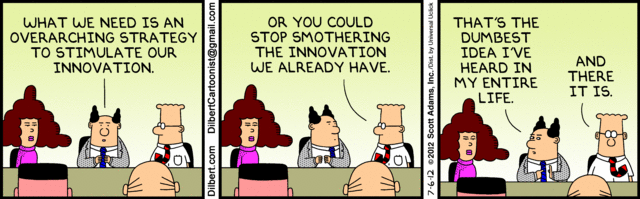
Power of Ignore (Or Ignorance)

ig·nore  verb   —refuse to take notice of or acknowledge; disregard intentionally.

fail to consider (something significant)

If you’re like most people you probably deny you ignore problems. But it’s more common that we think.
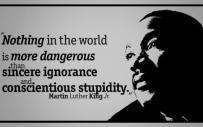
martin

In fact, ignoring a problem is a coping mechanism we’ve used since cave-man days.   Often it’s easier to ignore a problem instead of trying to solve a problem. If we deem there is no problem then there is no worry about solving a problem that we deem doesn’t even exist!

Personally, being ignorant (a variant of the verb ignore) is a survival mechanism. If facing our problem is not directly linked to survival we make it a lower (or no) priority. Once survival needs are met, it’s easy to ignore other problems. With this mantra, our life seems to become easier…. But this is a fallacy. Ignored problems never go away. What was a small issue becomes a great problem when it is ignored over time.

There are dozens of business examples failing when leaders ignore problems. When the business leaders fail to critically examine policies, process, the market, customers, and trends they ignore potentials problems.

Ignoring problems (or failing to try to proactively find and solve problems) is a failure of leadership.

During the 1990’s my friends were in the 1-hour photo business. Things were profitable for more than 10 years. Business was good. It was easier to ignore future problems. In their business world nothing was changing. Yes, there were some stirrings of electronic digital cameras in a distant horizon, but that technology was expensive. In 1995 a good digital camera cost between $5,000 – $6,000.  There was nothing to worry about. Customers always wanted the cheaper and more convenient 1-hour service. My friends ignored the issue… After all, they had a government contract for film development.  Ignorance was bliss—that is until digital cameras oversold film cameras in 2003. My friends went bankrupt.

Blockbuster video opened first in Dallas Texas in 1985. Nine years later Viacom bought Blockbuster for an unprecedented $8.4 billion. Blockbuster ignored Netflix as a competition. Blockbuster ignored the change in the video market from stores to subscription home delivery. Blockbuster executives literally laughed aloud at a 2002 offer to acquire Netflix. Blockbuster ignores kiosk rental service beginning in 2003 (Redbox). Blockbuster ignored the customer complaints of late fees for 14 years. In September 2010 Blockbuster went bankrupt. Ignoring the changing market and customer needs was expensive.

Circuit City was a 60 year old electronic and appliance behemoth and went belly up because the executive leaders ignored basic problems.

After 120 years in business Kodak Eastman went bankrupt in 2013 because it ignored its core business. Kodak insisted it was in the “film” industry and ignored “digital imaging” as the new paradigm.

This is not unique to business. Government and police organizations litter the landscape with examples of failure due to the power of ignore.

A victim reports a sex crime. The police officer waits a few days to ‘check in’ to the allegations. Ignored and avoided, the victim went to the local news outlet to get answers. The Chief of Police is then explaining the lack of timely response by the officer and trying to avoid a public embarrassment. The officer is censured for ignoring the call for service.

A senior executive received damning information about the organization. The boss gave the executive a mandate to investigate and find the validity of the information. The executive delayed 2 months to beginning an investigation. The message is: Ignore a message long enough and it may go away. Conversely the thinking is: This issue isn’t serious enough to put energy into it. They ignored the seriousness of the allegations.

An agency chief bemoaned aloud that there was no accountability for his executive staff.   He indicated there were no measurements to determine if the junior staffers were being effective. Eventually he decided there were no effective way to measure efficacy of staff work; so the problem went away. He ignored the real issue.

Months ago a senior executive administrator was asked a similar question: “What are the matrices or benchmarks associated with [a key position in the organization]? After the executive stopped laughing (yes, he literally laughed out loud), he said:

“There is no way to measure effectiveness in [that position]. There are no benchmarks or matrices.”

Essentially he said no problem exists, so we can ignore a problem we haven’t specified.

What are the differences between these responses?  In substance, the officer, the senior executive, and the chief was ignoring or denying that problems exists. This is a leadership fail.

The reason business and government leaders ignore problems is because they fear change. Period. Dr. Robert Kriegel (Sacred Cows Make the Best Burgers) wrote that in 1996.   News flash: 20 years later— NOTHING HAS CHANGED.

In 2016 John Kotter (author of That’s Not How We Do it Here)  postulates organizations need disruption and stability to thrive.   Management is about stability.  Leadership is about disruption.  There is no place to ignore issues.   Leaders disrupt. Leaders need courage.

Organizationally blissful ignorance is sometimes the modus operandi. For managers and supervisors it’s easier to ignore problems rather than try to effect solutions. Maintaining the status quo is safer than working to solve an issue. The mantra seems to be

If it ain’t broke, don’t fix it

Dr. Kriegel says new mantra should be

“If it ain’t broke; Break it”

Kriegel says we must face our fears and embrace whatever change we experience.  There is no dodging the rapid change of society.  Things change more quickly than it used to and the pressures can be intense.

The opposite of ignorance is not knowledge.  The opposite of ignorance is courage.  The solution to ignorance is to develop courage.  We dispel ignorance by courageously asking questions and seeking answers.  If we, as leaders, experience courage then our knowledge grows and our ignorance doesn’t have so much power.

We must have courage :

  • To look at the unknown
  • To ask questions that are uncomfortable
  • To challenge the status quo
  • To act when action is needed
  • To be politically incorrect
  • To “get it wrong”
  • To see past the platitudes and seek causal issues
  •  To feel discomfort and move past it

Yes, there is a power to ignore…. But ignorance not a positive power.

Of course, your mileage may vary…

Dr. Jay



What Can I Trust?

I am haunted by my hospitalist words. It was the next day in the ICU,  after being admitted for my CVA (Cerebrovascular accident).   My doctor spoke with a slight Russian accent.  Her tone was very ‘matter of fact’, like a weather forecast, or like an un-engaged bureaucrat issuing droll hum-drum tax information. She said:

“You’ll never work as a police officer again…. Maybe it’s time you get nice office job”

I was stunned. I thought “you don’t know me”. I was outraged. I was hurt. I couldn’t hear anything else this doctor told me. I insisted that she leave my hospital room. How could this doc know this with such certainty?  I didn’t trust her words.

It’s almost 8 months since she told me this.  I’m still not working as a “real” police officer.  I’m still on light duty.   Her prophecy has slightly cracked my shell and I finally conceded she might be correct.  Last week my speech therapist told me “you’re not progressing as we thought you should have been”.   I still have trouble remembering how to pronounce words.  I can see an object and can identify it, but I cannot remember or say the word to identify the object.   I can’t trust my brain.

I was describing a church pew.  The word “pew” wouldn’t come to my thinking.  I could only remember how to say it when the person I was talking with asked me “pew, right?”  Not that “pew” comes out in conversation very frequently, but it was disturbing I couldn’t remember a word that is this familiar to me.  I can’t trust my vocabulary.

I like to sing.  I’m not a professional singer, but I enjoy it.  I’ve been singing all my life and literally knew the lyrics for over 1,000 songs.  Now I can remember the melody line, but not the lyrics.  This week I spent hours trying to remember the title of our national anthem.  Weird, since I’ve performed “The Star-Spangled Banner” several times.  Now I can remember the title and the opening line — the rest of the lyrics continue to elude me.  It’s frustrating, I can’t trust my memory.

There are more foibles I am unwilling to share in this forum.

I did chat with the city’s disability guru.  She was pleasant, but seemed to know something I wasn’t willing to admit.  She said when I am ready to come back to work it “might not be at the police department”.  Strange she knows more about my possibilties than I know.  I don’t trust the city’s best intentions.

I’ve been very absent writing because it is very hard to write for me right now.  Not the content…. That’s the easy part.  So that I do not sounding like a whiner…. And putting these ideas in readable sentences that make sense…. And not showing my self-disgust for not getting better quickly…. These are the challenges.   I don’t trust my writing.

AFGO— Another freakin’ growth opportunity…. I just don’t trust it….

Of course, your mileage may vary.

Dr Jay Irvin


Guilt by Light Duty

stroke2

Since March this year I’ve been on ‘light duty’ as a police officer.  March 1, 2016 I had a CVA– a stroke– a brain attack.  As CVAs go, this was a mild one.  I was blessed.

Since then I’ve not been working as a uniformed patrol officer.  I’m writing this in late June and will be away from patrol until early October.  I’ve had a lot of time to think.

My current ‘light duty’ assignment is to create/write/develop a curriculum for the Crisis Intervention Team (CIT) for the police department.  It’s a big job and a necessary one.  And I may be the best capable guy to do that… Considering my education, training, and expertise in training.    Originally I was to assist other CIT members developing the curriculum, but the focus changed; then I got the mandate to ‘just create’ the curriculum.

Being on ‘light duty’ is a pariah.  I’ve always had a hard time ‘belonging’ and this makes it harder.  I’ve heard comments such as “How long are you gonna keep gold-bricking?” and “You don’t look like anything is wrong” and “You sound like fine to me” and the best comment– “You must love this not having to be on patrol”.   Patrol staff is always short.  Officers on light duty create more work for the patrolling officers.  I feel guilty.

I don’t have a bandage or a sling or a cast or visible bruising.  My issues that prevent me from working patrol are unseen issues.  My language still isn’t right.  I still have a stammer and stutter.  I still search for correct words.  I still struggle with pronunciation of common words.   My writing is laborious.  I call my mis-speaking and mis-writing as “stroke-isms”.  Humor is best way (for me) to deal with what I’m going through.

My organization has been outstanding. The administration seems to be patient with my recuperation.  And I’m doing that which no-one else wants to do… And I like doing it.

To be a ‘true’ police officer I know I should never admit to liking anything. ‘Real’ police officers bitch and moan and complain about no matter the task.  That doesn’t work for me…. About 30 years ago I decided that I would enjoy whatever I do or wherever I am.

My goal is to enjoy my station in life or work and try to live with grace and patience.  I want to enjoy whatever I do.  I must find the value in my moments and like them.  Of course, to live with grace, I need to leave my ‘guilt by light duty’ behind.  This is a chore for me.

Self-improvement work continues…. doggone it…. Back to my chore.  Like I said, I’ve had a lot of time to think….

Of course, your mileage may vary…..

Dr Jay


Don’t be That Guy

stroke2

I work in a field where we’re known to “eat our young”.  I know that is not a flattering statement to say about a profession, but it’s truer than we want to admit. As a police officer you either figure it out or find yourself looking for a new job.  We smugly say “Yep, being a police officer is not for everybody” and give out walking papers like they were business cards.

Part of me is very happy there are high standards for police professionals.  With all the national scrutiny and the national dialogue not friendly with law enforcement, it does take a certain type of person to do this job. I used to be this type of guy.  Post stroke I’m having to find my way back to  who I used to be.  I feel I’ve been evicted of my identity.

For example, writing used to be therapeutic for me.   Now it’s a chore.  Simple police reports require more re-edit that I am used to doing.  Goofy.

I hope my grammar and syntax fluidity will come back too.  I’m having a challenge with homophones and spelling.  I know the different between there, their, they’re and by, buy, bye; but my writing hasn’t displayed my knowing!

My friends tell me my speech is getting better…. by the week…. I saw a friend, whom I’ve known over 20 years, and commented he could not even really hear my verbal gaffes…. barely.  He is kind.  Improvement is good.

I’ve found a problem with me using gender and pronouns.  I’ve caught myself referring to ‘she’ when I’m talking about a ‘he’ … And vice-versa.  My spelling  is showing some inadequacies too.  I could not, for the life of me, spell ‘mannequin’.  I couldn’t even get my auto-correct to find the word for me…. I was able to find the spelling by my on-line thesaurus…. This week I forgot how to pronounce “opinion”… Which is odd, since I have some many of them…. Kinda funny for me, actually.

My doc tells me there isn’t much treatment (except time) and continue my therapies.  I feel like I have to continually explain myself.   We have protocol for physical maladies, but nothing for unseen neurological damage.  There is no cast to remove or there is no bruise to heal or there are no stitches to remove.  The healing is invisible.  This is a hard concept for “that guy”.

I will get my language and grammar and speaking capacities back.  The problem is I don’t know when.  The speech pathologist seemed to think of months… not years.  That was encouraging.  Yet, I have not been kind to myself.  I have been “that guy” to myself.  You know, the one who says “Just suck it up”.

The day I was hospitalized my language was about 30%.  It was apparent to anybody communicating with me.  A month later I was 75% (maybe).  Two and a half months later I’m 80% back.  These percentages are just my estimates.  The docs won’t give me percentages.

I have a stammer and stutter that I never had.  My speech issue exacerbate by stress– And this is a stress job.  (My internal “that guy” dialogue is beating me up for whining too much as I write this.)  Damn the humanity it all….

I still maintain I am blessed.  And I am humbled by this experience.  AFGO (Another freaking grow opportunity)….

Of course, Your mileage may vary

Dr Jay


Cult or Culture?

Comicculture

For the past couple of weeks I’ve been privileged to attend a leadership training developed and sponsored by my department.  I’m a street cop in a city of about 100,000 people.  Our department has about has over 200 staff members (including volunteers).     I’m a tiny part of my outfit.

The class had just over 20 attendees ranging from a police commander to a secretary.  A majority of the members were sworn officers who work patrol.

The class was developed and delivered primarily by our Lieutenants.  Our command staff was present and involved.  I can honestly report this was one of the best leadership classes I’ve attended.  The material was relevant and real.  There was a great mix of discussion and discourse. There was an academic freedom that was encouraging.  And probably most telling: There was ‘buy in’ from the leadership and participants.

When I returned to patrol and reported my synopsis to my fellow patrol mates they accused me of “drinking the Kool-Aid”.  Which got me thinking….

Was I part of the cult? Or was I helping create the culture?

 In my mind there is a great difference between cult and culture.  Cult connotes a religious fervor gone off the rails.  Culture bring images of refined tastes.  Frankly, I’ve very seldom been accused of having refined tastes….. But I digress….

In defining organizational culture we look at a very large set of value assessments held in common by the people in that organization.  Buying into a culture doesn’t require perfect conformity.  Not every member has the exact same value assessments as each other, but people belong to a similar culture if they have “buy in” and “tolerance” for the deviations among the group.

Fact is, this tolerance and variance is a basic difference between cult and culture.  A cult requires control.  Generally there are four areas of control that scream “CULT”.  They are:

  1. Behavior Control. Individualism is discouraged. Group-think prevails.  The individual must be obedient and not deviate from the accepted rituals.
  2. Information Control.  There is a strict “need to know” mentality.  Access is limited.  There is no transparency.
  3. Thought Control.  The cult doctrine cannot be questioned. Dissent is discouraged.  There is only one truth.
  4. Emotional Control.  Fear is the overriding emotion.  Create a phobia about questions or leaving the group.

In our leadership course almost the exact opposite was encouraged.  Our teaching staff laid out some ideas for developing and refining our culture.  They suggested our organizational culture is about:

  • Positive empowerment and leadership
  • Taking calculated risks with room for mistakes
  • “Failing forward”
  • Creative and positive internal and external customer service
  • Personal and organizational growth, development, learning
  • Question the status quo
  • Compassion and collaboration

Here’s a comparison of cult and culture. (Courtesy of Prepare International)

CULT
1. Emerges quickly with a forceful leader
2. Based on the personality of the leader
3. Fragile and volatile due to the leader
4. Future lasts as long as the leader does
5. Survival rests on a personality
6. People are controlled from the top
7. Leader pushes values on others
8. Works through compliance
9. Centralization (positional power)
10. Can breed fear and insecurity
11. Low risk, low reward
12. The leader leads followers
13. Short term/fleeting success
 Versus
 CULTURE
1. Emerges slowly in time with a leadership team
2. Based on the shared values and goals of people
3. Durable and robust due to the environment
4. Future lasts as all transmit to next generation
5. Survival rests on shared belief & experience
6. People are empowered from the top
7. Leaders model and teach competence and passion
8. Works through commitment
9. Decentralization (personal power)
10. Will breed love and respect
11. High risk, high reward
12. The leader creates leaders
13. Long term success
So whether I ‘drank the Kool-Aid’ or not is up for interpretation…..
And of course, your mileage may vary.

My Newest Bias


I was listening to a segment on public radio as I was driving to get dinner yesterday and heard an interesting bit on “white privilege“.   A white rapper sung and wrote about supporting a black protest. In his solidarity with non-whites, he questions his own credibility as a white supporter with his white privilege.  (Read more)

I’ve been familiar with the term “white privilege” since the 1980’s.  The term has actually been around since about 1935, but race or privilege wasn’t discussed in my family growing up.  The only societal label that stuck to me was “poor white trash“…. And it was used to describe my family.

“Poor white trash” is a euphemism for lower social status white people usually in the rural south.  Other equally derided terms may be “redneck”, “Okie”, “hillbilly”, or “cracker”.  White trash, as a slur, has been around since about 1835.  Harriet Beecher Stowe even included a chapter about white trash in A Key to Uncle Toms Cabin.

I don’t pretend to know what it’s like to be black or brown in America.  I can only be grateful that I didn’t turn out to be what my dads expected from me …. “You’ll wind up dead or in prison” He frequently predicted prison before I was 30.

My dad was a violent man.  He was a World War II veteran and had scars on his arms from shrapnel wounds.  He never spoke of his experience. I found out he was an Army infantryman in Europe for 4 years, during the thick of war.

He’d grown up in the Appalachian foothills of North Carolina where he had a hardscrabble life.  His mother was a “working girl” and his dad was a “john”.  She lived in the city and tried to raise him for a while.  At about age 8 my dad was sent back to the hills where he was used as labor for familial friends.   There was no schooling for hillbillies in that area then. Completing the third grade was a triumph compared to some of his contemporaries.

He learned to fend for himself. He fought off sexual attacks, sometimes winning and sometimes losing.  He fought for food. He fought for a place to sleep.  His world was truly survival of the fittest. Some of the things he never outgrew…. As a kid, I remember him placing his wallet in his pillowcase while he slept.  Old habits die hard, I guess.

He suffered in that hellhole from 1927 until about 1937.  The Great Depression was in full swing.  He stole his uncle’s truck and left when he was 17.  Times were tough for everybody…. Particularly an uneducated, unsophisticated teenager with no skills and no prospects.

He lied about his age and joined the National Guard in 1938 to avoid being drafted into the war.  In 1939 his unit was activated and he served on active duty until 1946.  He made Corporal and Sergeant three times.  Of course he got busted three times.

After the war he worked several laborer jobs.  In the mid 1950’s he became a commercial baker.  He moved to Winston-Salem, North Carolina and tried to re-connect with his mother.  She’d settled into her life and was working at the RJ Reynolds Tobacco Company.  She was acquainted with my mother’s dad who worked at the same place.

My mom was just returning from Texas (with a two year old child) and no husband.  She was 19.  Her dad told her she needed to get some stability and knew a guy who she may be interested in.  They married when she was 21 and he was 40.   And I was the progeny of that union.

Life was not idyllic.  My dad wasn’t the stability he was purported to be.  He was violent, moody, and changed jobs often.  Usually his job changes came because of physical confrontations with management.  He worked as a laborer in textile manufacturing, a box factory, a jelly production plant, a fiberglass manufacturer, and a janitor in food service.

He was not a man to be trifled with.  He meant exactly what he said.  If he said “Stop it” he meant “Stop it”.  He didn’t say it twice.  He didn’t give idle threats.  Whatever he demanded, he could back up.  I saw it frequently.

When he told me “I’ll put you in the ground and make another one that looks just like you” I believed he meant it.  I saw him shoot our family dog, who loved my dad more than anybody else.  Dad showed zero remorse…. Just “boom, boom” of the shotgun and “yelp”.  Lucky was dead.

From about age 11 until I was 15 I took a beating from him about every other week.  I don’t mean a spanking or a paddling.  I mean a beating.  Fists, belts, sticks… whatever could inflict damage.

When he said I was “white trash” I believed it.  The “poor” was never in question.  I got my first job at age 12 to pitch in (and have been employed since).  I was earning huge at 65 cents an hour.  There weren’t many extras in our household.  I never remember our family never ate at a restaurant together until I was in high school.  My sister tells me we did.

There is a moral toll that comes with being labeled as a small child.  That early self-image is hard to shake.  I don’t know where my desire to prove him wrong came from. But I was determined to show my dad that I was more than “poor white trash”.

I was 18 when he dropped me off at college (I earned a full-ride scholarship for academics). It was the first time he ever said “I love you” to me. In fact, that’s the only time I ever remember him telling me that.

Eight years later I flew him out to Texas to see me commissioned as an Air Force Lieutenant.  He never told me he was proud of me.  I found out later he told anybody who would listen about his “military officer son”.

All this brings me here:

This week, in a leadership class (developed and delivered by my department), we had a discussion about bias.  I know I have them, but I didn’t realize this one until I heard the NPR report.

My newest bias is a distaste for you if you assume you know me because of my skin color.  I can’t reject “white privilege” because I know as a society it exists. But when I heard the radio commentary about “white privilege” I cringed.

While I may have enjoyed “white privilege”, I certainly have never felt it.  If anything, I still work against feeling like “poor white trash”.

Of course, your mileage may vary.

Dr Jay

Live Like You Were Dying Pt 1

This is an excerpt from my book “How to Live Like You Were Dying: Notes from a Cancer Survivor”        Originally written in 2005.

llywdying

Chapter One

 
“O death, be not proud” from Sonnet X, Jon Donne

 
For most of us, the good news about dying is that we don’t know when it’s going to happen. We don’t know when we are going to die. And for most of us we don’t use the term “good news” and dying in the same sentence, but I’m getting off point.

For most people when the idea of passing away comes up, ignorance is bliss. Psychologists call it denial. To me, it was just the way I lived. For me it was normal.

I never thought much about dying. I certainly didn’t worry about it. I certainly never considered writing about dying. Happily, this isn’t about dying. It’s about how to live. It’s about how I learned to live based on circumstances in my life. It’s how you and I might live better if we have an awareness of our mortality.

On the rare occasion I thought about the possibility of dying I didn’t think it would be my turn soon. I often joked that I wasn’t afraid of death… I just didn’t want to be on the next bus load. I laughed when other people joked about dying; the old joke that they didn’t mind death, it was the dying that was a nuisance. In short, I didn’t make much space in my thinking for mortality, death, or dying.

But who does? Certainly none of the people I knew or associated with did. We were macho. We were immortal, or so we thought.

I only casually thought about death when I brushed past it in my life. A long-time loyal bar customer had an unexpected heart attack and I said a few words at the eulogy. A cherished employee passed from AIDS related disease and I told him “Thanks & Goodbye” in the hospice. A student friend had gotten killed in an automobile accident and it was a shock.

My best friend from grade school was killed in a motorcycle wreck, but with his reckless life, I kind of expected it. Even my father had passed away years before from heart disease near age 69. But I was unfazed; he was in poor health and had heart disease.

I never considered my mortality. As I moved from my 20’s to 30’s and into my 40’s I felt my body change. I got tired easier, I got heavier. I got “soft”. Some would say my body was deteriorating and there’s a medical argument for that, but I never considered the possibility that I could be dying. I never considered that I could be dying soon.

It was a big shock when my oncologist diverted her eyes from mine on our first office visit and told me at best, I had six months to live.

SIX MONTHS? That’s only 180 days. How could she give me this “death sentence” with such certainty? How could she not look me in the eyes when she said this? What was so important on that paper that she had to look at it when she delivered this shocker to me?

I was shocked. I was in disbelief. The doctor had to have made a mistake. I didn’t feel like I was dying.

After all what kind of credibility could she have? She had a bad hair color and dandruff! Her hair was a little greasy and unkempt. There were dandruff flakes on her shoulders. Her roots didn’t match.

Here was a medical doctor, an oncologist, a trained professional giving me devastating news and I was focusing on her personal grooming habits and lack of style! It’s amazing what tricks the mind can play when one gets such shocking news. I was getting the worst possible news in my life and I was criticizing my grim reaper’s lack of élan.

I was judging her for letting her roots show, so that I barely heard the “death sentence”.

Of course your mileage may vary.

Dr Jay

Free Your Mind

GeorgeCarlin

I’ve really enjoyed George Carlin.

I just finished reading his self-described “sortabiography” (Last Words).  George started writing it years ago and his agent/manager finished it for him after his death.

Just like in his comedy show, George doesn’t pull punches.  He writes about his pain and path.

George was a daily pot smoker (no surprise there), a heavy cocaine user, and a functioning alcoholic.  What really disappointed me was Carlin credits his success to his use of LSD. He relates that LSD opened his mind to be more creative and lose the “bullshit” of his upbringing.

Carlin was raised to be hyper-Catholic in a dysfunctional family with an abusive alcoholic father and a manipulative-overbearing mother.  Mom eventually left pops and then poverty became an issue.  George, for the most part, was left to raise himself.  Unfortunately this is not an uncommon tale.

George left home to join the US Air Force at 17.  His plan was to become a radio personality, a comic, get famous, make movies, and then ‘have it made’.  What George didn’t know is that leaving home is only a geographic solution.  While you can move 1,000’s of miles away from home, your ideas of home/family still move with you.  Psych docs call it ‘family of origin issues’.

Trouble followed George and, as can be expected, the military was not a good fit for someone railing against authority.  His Air Force career was cut short and he started his broadcasting career.

George masked his pain and issues by self-medicating.  There was the liquor and pot.  And in the later 60’s he found hallucinogens.

I identified with George up to that point.  I had serious ‘family of origin’ issues.  My mom was a hyper-religious, manipulative over-bearing sort.  My dad was emotionally absent and was not a good man.  We were way below poverty standards.  I escaped to the military.  I left the Air Force prematurely. But I didn’t choose hallucinogens to “free” myself.

I’ve never used LSD or peyote or mescaline.  I’ve never licked a frog to get high.  I’ve never tried cocaine or heroin.  I’ve never even smoked pot (gasp). I don’t understand ‘huffers’.  I drink very little alcohol now.   I did drink too much in my 20’s and 30’s.  But experimenting with drugs is completely foreign to me.

Yet I did find ways to have the success I wanted without drugs.  And I’m still working to achieve additional goals– chemical free.

I have studied the human mind. I have studied how to and have experienced an alternate consciousness via meditation/hypnosis/yoga.  I don’t know if it’s like an LSD high, but it’s close enough for me. My first out of body experience came in 1987 flying back to the US from Spain in the webbing flight seats of a C-141.  There was just enough engine noise and I was just woozy enough to experience this altered state.  It was eye-opening.

I’ve been able to re-create the out of body experience several times and never with drugs.  It’s like any exercise… the more you practice… the better you get.

ALANCohen
Alan Cohen

Years ago I went to a class Alan Cohen taught.  Alan’s course was how to live truer to one’s values…. How to be more authentic….  I’d read and enjoyed Alan’s books…. I liked the way he wrote.  Alan inspired me.  I asked him what the secret to his mind-expansion was… he said “LSD”.  Another potential ‘hero’ down in flames….

But maybe that’s why I’m a good cop. I’m very ‘straight’.   I don’t relish the idea of self-medicating and I don’t wanna ‘get bombed outta my gourd’.  Maybe I’m a self-control freak?

I’ve realized I can learn from anybody.  Even from those I don’t care to emulate.  And I’ve learned I can be happy and create emotional freedom without medication…. perhaps that makes me the lucky one?

Of course, your mileage may vary.

Dr Jay

Servant Leadership

Servantleadership

I was looking through some leadership and management lesson plans from 10 years ago.  I wasn’t just strolling down memory lane….I was on a mission.  My sergeant (knowing my teaching history) asked me to send some leadership/supervisory training material to her.

My sergeant is doing a great job (from my perspective), particularly for a first year supervisor.  And when, as a boss you wanna learn more, this is a good thing.  But I digress.

As I looked through my old work, I was reminded of some leadership fundamentals that I just take for granted.  I assume everybody knows what I know.  The truth is good leadership can be a scarce commodity.

To me the definition of leadership is simple:

Leadership = Influence

I know there are many more complex definitions of leadership, but I think there is more profundity in simplicity.  Either that, or I’m just a simple guy.

Reading back over my teaching notes and looking at my slides I see an obvious connection between attitude and leadership.

So you know, I define attitude as:

The perspective or lens you use to view the world.

Here’s the slide that jumped out at me:

ParadigmDifferences

I know effective leadership is “Esteem based” not “Ego based”, yet how many times do I let my ego get in my way of being effective?  Don’t answer, it’s too many times.

It happened recently. I didn’t feel supported in an issue at work this week (Not involving my sergeant, to be clear).  As I worked through the issue, I know I wasn’t as effective as I could have been because I had a ‘need to be right’.  My ego got in the way.  Good thing I’m still learning and growing as a human….

When I was about 16 or 17 years old a boss told me “To be a good leader you must have a big ego”.  In hindsight, I think he was just trying to justify his huge ego because he was the boss.

I think what my slide really refers to what is called ‘servant leadership‘.  It’s the opposite of ‘power driven’ leadership.

I’m no expert, but I know it when I experience it.  And I hope it’s something I demonstrate it on occasion.   It’s a living example of Ziglar’s “You will get all you want in life, if you help enough other people get what they want”.

Servant leadership requires working for the greater good.  As a public servant I know this.  Now if I can only live what I know!

Of course, your mileage may vary.

Dr Jay

Do Be Have

BeDoHave2

Years ago I uncovered an idea…. The Do-Be-Have model.  I always thought it was something that came to me out of my consciousness, but I’m sure I heard or read it somewhere.

This was pre-internet. This was when real ink and paper books mattered. I was a voracious reader then (1-2 books a week). I was a military officer (Captain in the US Air Force) and was writing intermittently.

I was going to write a major self-help/pop psychology book.  My working title was:  3 Realities of Life.  I even had a concept for the cover art.  It was about this time (mid/late 1980’s) that the Do-Be-Have model percolated to my mind.  It was Part I of my book.

In short, the Do-Be-Have model is about who we are and how we see ourselves.  It’s about self-identity…. paradigms….the lens you use to view the world.

In Western culture very often we identify who we are by what we DO.  This is the essence of a business card.  And the perennial question at a dinner party…. “So, what do you DO?”  We summarize what we do in one statement.  I’m a street-cop. I teach kids. I work for Intel. I’m retired. I’m a golfer….

The other way we often identify who we are is by what we HAVE.  “I have a doctorate” (I HAVE a college degree) or “I’m a mother” (I HAVE children).  Or I’m a home-owner or I drive a Mercedes or I have cancer or I am a blonde….

Very seldom do we identify ourselves by what we BE.  The essence of humanity is to exist.  We just are.  One of the challenging assignments I have given my classes over the years is to describe oneself by “who you BE”…. without referring what you have or what you do.  Try it… it’s challenging.

If we figure out first who we are (BE) then we can decide what we want to HAVE  (goals, aims, directions) and combine those (Be+Have=Behave).  Behave tells us what to DO.

In our culture we have the order backwards.  We DO first, then figure out what we want to HAVE and usually never worry about BE until a crisis hits.  If we decide we want to HAVE more, we DO more.  This is an illusion, but DOing is limited.  BEing is not limited.  The truth is if we BE more our HAVE will increase.

Part I of the book was Do-Be-Have ….. in great detail.

Part II was the 3 Realities… They are:

  • Reality… The way the world really is… Independent of your bias or mine.  True reality.  No spin.
  • Industreality…. The way the world works.  Girls do this; boys do that.  There is “black or white” “good or bad”. The world of implicit and explicit biases. The why-everything-works-as-it-does reality.  The reality of limitations. Why a runner can’t break a 4 minute mile barrier.  Why carbon based fuel is the future. And other “rules” that will consistently be broken by innovative thinkers and do-ers.
  • Surreality…. The reality of the imagination.  This is the only way to achieve dreams that are worth.  The ability to act “as if” and move through industreality into a new reality that you have created.  This is what Thoreau wrote about.

Part III was how to implement these ideas into practice and move from Industreality to your own Reality.

I haven’t written the book (yet).  I did, however, live the 3 Realities of Life.

I moved from my Industreality of violence and sexual abuse as a child: to my reality of protecting the abused and prosecuting the abusers.

I moved from the Industreality of my family of origin issues; to my reality of having  great family.

I moved from the Industreality of being diagnosed with ‘terminal’ cancer with six months to live; to my Reality of becoming cancer-free five years later.

I moved from the Industreality of losing my health, my job, my family, my business, going bankrupt, and being told “you’re too old”; to my Reality of becoming a street-cop at age 50+.

Maybe I will write that book… maybe…

Of course, your mileage may vary.

Dr Jay