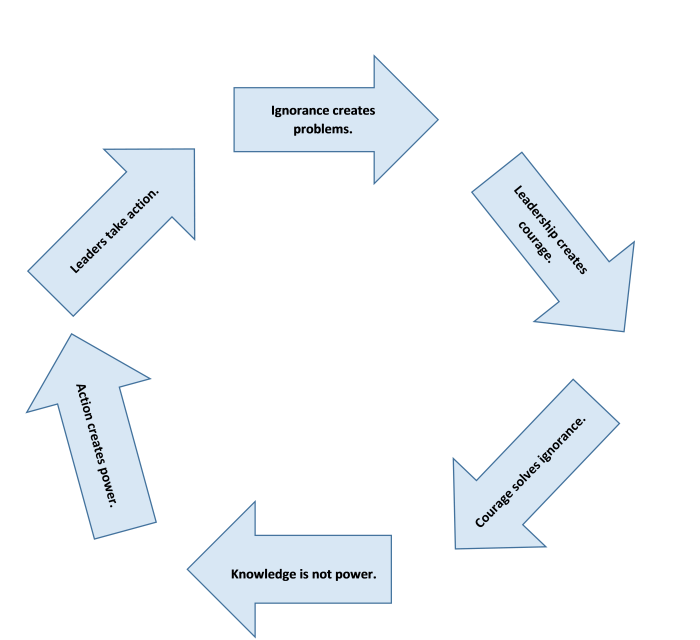
CIT Leadership Initiative Model

  • CITModelIgnorance creates a problem.


An issue or problem exists, but there is no long-term solution. There are Band-Aids applied… there is rhetoric… there are grumbling and grousing… The problem is ignored. The problem may be small and seem small for a while. But that same problem that seems small may grow or fester. An ignored problem does not go away. Labeling a problem other than a problem does not make it a “not” problem.

Look for problems. Never accept there is no room for improvement. Good may not be good enough.

Encourage criticism. LB NT… Liked best… next time…. 5 likes, 2 next times


  • Leadership creates courage.


Leadership, at its core, is action. Leaders have a bias for informed action. A leader finds the ‘problems’ and work to solve them. Usually this involves posing several courses of action and risks— The leader takes one course of action, adjust, refine, correct, & re-act. The care needs to be addressing the real problem… If it (whatever it is) doesn’t improve, ask different questions.

Which comes first? The courage or the leadership? Kind of like the chicken and egg question.

If you don’t like the answer, change the question.


  • Courage solves ignorance.


Courage is the opposite of ignorance. Looking at the problems, asking questions, not settling for status quo, seeking courses of action, taking action, re-evaluating, adjusting action, and paying attention will solve the ignorance issue. This is courage in action. Action is leadership. Leadership will solve ignorance.

There is a fine line between courage and stupidity. Know courage is in short supply. When you display courage you will rise to the top.

Ask for input. Your eyes are only yours. They have fresh eyes… use them too.


  • Knowledge is NOT power.


Sir Bacon Francis, in a book titled Religious Meditations, Of Heresies (1597) wrote “knowledge itself is power”. He was half right. Knowledge without action has little power. To know but not act is true heresy. Francis was commenting on the church and their lack of dogma transparency. In current days, knowledge is common. Almost every human knows how to lose those few last pounds… Eat right, exercise more, don’t eat just before bedtime… It’s not the knowing that makes a difference, it’s the action.

Going to training will NOT improve your CIT program. You must do some work. It’s you… not them.

Your circle of influence expands when you share your knowledge.


  • Action creates power.


There is no substitute for action. Education, knowledge, classes, more knowing… Nothing will outperform taking action. Being the greatest running theorist does not make you a great marathoner. Only running makes you a good marathoner. The universe does not like a vacuum. If there is no positive action, a plot of ground will become weed and vine filled. There is no garden without a gardener. The most knowledgeable gardener must act to get positive results.

Action isn’t a solo act. There are others, just don’t wait for ‘them’ to act. You take action first.

Specify the 3 next steps for your action. Then act. When that’s done, figure your next 3 steps… Then do those… Repeat…


  • Leaders take action.


Because there is no substitute for action, the leader acts. The leader creates personal and positional power by action. This action ensures the one who acts will be essential. Action does creates problems for those who do not act… particularly if they are in positional power posing as a “leader”.   Some positional “leaders” do not act… Action has risks. For instance, you could fail or you could make a mistake. Which leads the circle back to the leadership model where a problem was created by ignorance. The leader never finishes. They adjust, learn, find courage, and act.

Leaders are introspective and take responsibility for their action.

Leaders foster a culture of action (and mistakes). There are zero errors when there is no action.

The CIT Leadership Initiative is a non-profit corporation (503c) for the education and proliferation of CIT Training and community policing.  For further information contact CITLeadership@mail.com 

Of course, your mileage may vary

Dr Jay
I Am a CIT Evangelist

e·van·ge·list/əˈvanjələst/ noun

  • a person who seeks to convert others to the CIT thinking, especially by public exhortation and living the CIT principles.


“Evangelist” is a great ‘tag’ to start because every great idea begins with passionate and great thinking. Great ideas are pushed into being by, change agents or “evangelists”. Evangelists don’t just drink the Kool-Aid, they live it and truly believe in the innovation they espouse.

What separates true evangelists and change agents from the rest of the flock is the intangible fire they possess. Evangelists are willing to bet their political capital and careers on a new ‘disruptive’ process or idea. Evangelists will talk about their project or interests; not just to those interested, but to their colleagues during lunch, their friends when not working, and more.

Evangelists are very persuasive. They are absolutely essential to getting buy-in from the rest of the organization. They are also the ones to convert the first couple of flagship participants. If at least a percentage of your crisis intervention team does not consist of evangelists, the team has a good chance of failing.

Why? Because evangelists conduct themselves like mini-CEO’s. And that’s what you need at a time when roles and responsibilities are still in the process of being defined. You need go-getters, self-starters, and learn-as-you-go people who are willing to put on different hats rather than expect to delegate to an assistant.

Evangelists get their hands dirty. They are not just theorist—they are practitioners. They are willing to work, do, and try. They are willing to show a critical eye, but are also willing to find alternates instead of just criticize.

Only an evangelist can convince a crusty patrol veteran to try a small innovation in dealing with the mentally ill consumer.

Further, evangelists will help you to recruit other strong talent. The intensity of evangelists will probably scare off ho-hum bench-warmers and attract the A-team the big change initiative will need, especially in the formative months.

Years ago one of the men who helped form my world view taught me:

“Everything rises or falls on leadership. Everything.”

And I believed him. He was a true leadership “evangelist”. Dr. Lee Roberson (1909 – 2007), the founder and Chancellor of an alma mater, was fanatically about leadership. And as a result of his fervor, he impacted two generations of leaders.

I am a CIT evangelist. Join the crusade with me, won’t you?

Of course, your mileage may vary…

Dr. Jay

It’s A New Day

I’ve been through the grinder in 2016.

2016 was a crap year.  I had a stroke. Got divorced (again). Lost a position I really wanted.  I had to re-structure my job (and life).  There was Cheeto elected as commander-in-chief…  Adios 2016 and good riddance.  Hello 2017… It’s a new day.

But this is life.  Life is hard.  Wear a cup.

So I’m re-calculating my next move… It hit me like a grumbling tummy after a Taco Bell run… I have to adjust. I have to do what I’ve been training so many managers to do.  I have to  manage change in my life.

If I don’t get the job I wanted (I didn’t)… If I have to live with post-stroke language issues (I do)… How will I manage my life and how will I positively change my life to make adjustments?

For the past 9 months I’ve been the CIT ‘go to guy’ for CIT deliverables.  I’ve written the policies, standard operating policies, and training.  I’ve delivered training.  I’ve participated in the international and regional CIT conferences.  I’ve been a consummate CIT guy.

CIT, for the uninitiated, stands for “Crisis Intervention Team“.  CIT programs have grown for the past 20 years to help communities and police officers respond more effectively to mental ill and other crises calls.

When I was writing a CIT article one of the CIT guys close to the program read it and said “Ya know the way you write it, there isn’t that much difference between CIT and good leadership”.  This is when the proverbial light bulb above my head popped on!   I’m a CIT expert AND a leadership expert.

I’m passionate about leadership, BUT I’m also passionate about helping police officers find more effective solutions when dealing with people who have mental illness.   It truly is a new day.

I’m adjusting this blog.  I’m moving to provide tools for CIT members, leaders, and practitioners.

I do want to provide value… But of course, your mileage may vary.

Dr Jay Irvin

Power of Ignore (Or Ignorance)

ig·nore  verb   —refuse to take notice of or acknowledge; disregard intentionally.

fail to consider (something significant)

If you’re like most people you probably deny you ignore problems. But it’s more common that we think.

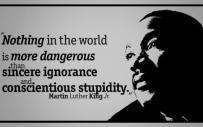
martin

In fact, ignoring a problem is a coping mechanism we’ve used since cave-man days.   Often it’s easier to ignore a problem instead of trying to solve a problem. If we deem there is no problem then there is no worry about solving a problem that we deem doesn’t even exist!

Personally, being ignorant (a variant of the verb ignore) is a survival mechanism. If facing our problem is not directly linked to survival we make it a lower (or no) priority. Once survival needs are met, it’s easy to ignore other problems. With this mantra, our life seems to become easier…. But this is a fallacy. Ignored problems never go away. What was a small issue becomes a great problem when it is ignored over time.

There are dozens of business examples failing when leaders ignore problems. When the business leaders fail to critically examine policies, process, the market, customers, and trends they ignore potentials problems.

Ignoring problems (or failing to try to proactively find and solve problems) is a failure of leadership.

During the 1990’s my friends were in the 1-hour photo business. Things were profitable for more than 10 years. Business was good. It was easier to ignore future problems. In their business world nothing was changing. Yes, there were some stirrings of electronic digital cameras in a distant horizon, but that technology was expensive. In 1995 a good digital camera cost between $5,000 – $6,000.  There was nothing to worry about. Customers always wanted the cheaper and more convenient 1-hour service. My friends ignored the issue… After all, they had a government contract for film development.  Ignorance was bliss—that is until digital cameras oversold film cameras in 2003. My friends went bankrupt.

Blockbuster video opened first in Dallas Texas in 1985. Nine years later Viacom bought Blockbuster for an unprecedented $8.4 billion. Blockbuster ignored Netflix as a competition. Blockbuster ignored the change in the video market from stores to subscription home delivery. Blockbuster executives literally laughed aloud at a 2002 offer to acquire Netflix. Blockbuster ignores kiosk rental service beginning in 2003 (Redbox). Blockbuster ignored the customer complaints of late fees for 14 years. In September 2010 Blockbuster went bankrupt. Ignoring the changing market and customer needs was expensive.

Circuit City was a 60 year old electronic and appliance behemoth and went belly up because the executive leaders ignored basic problems.

After 120 years in business Kodak Eastman went bankrupt in 2013 because it ignored its core business. Kodak insisted it was in the “film” industry and ignored “digital imaging” as the new paradigm.

This is not unique to business. Government and police organizations litter the landscape with examples of failure due to the power of ignore.

A victim reports a sex crime. The police officer waits a few days to ‘check in’ to the allegations. Ignored and avoided, the victim went to the local news outlet to get answers. The Chief of Police is then explaining the lack of timely response by the officer and trying to avoid a public embarrassment. The officer is censured for ignoring the call for service.

A senior executive received damning information about the organization. The boss gave the executive a mandate to investigate and find the validity of the information. The executive delayed 2 months to beginning an investigation. The message is: Ignore a message long enough and it may go away. Conversely the thinking is: This issue isn’t serious enough to put energy into it. They ignored the seriousness of the allegations.

An agency chief bemoaned aloud that there was no accountability for his executive staff.   He indicated there were no measurements to determine if the junior staffers were being effective. Eventually he decided there were no effective way to measure efficacy of staff work; so the problem went away. He ignored the real issue.

Months ago a senior executive administrator was asked a similar question: “What are the matrices or benchmarks associated with [a key position in the organization]? After the executive stopped laughing (yes, he literally laughed out loud), he said:

“There is no way to measure effectiveness in [that position]. There are no benchmarks or matrices.”

Essentially he said no problem exists, so we can ignore a problem we haven’t specified.

What are the differences between these responses?  In substance, the officer, the senior executive, and the chief was ignoring or denying that problems exists. This is a leadership fail.

The reason business and government leaders ignore problems is because they fear change. Period. Dr. Robert Kriegel (Sacred Cows Make the Best Burgers) wrote that in 1996.   News flash: 20 years later— NOTHING HAS CHANGED.

In 2016 John Kotter (author of That’s Not How We Do it Here)  postulates organizations need disruption and stability to thrive.   Management is about stability.  Leadership is about disruption.  There is no place to ignore issues.   Leaders disrupt. Leaders need courage.

Organizationally blissful ignorance is sometimes the modus operandi. For managers and supervisors it’s easier to ignore problems rather than try to effect solutions. Maintaining the status quo is safer than working to solve an issue. The mantra seems to be

If it ain’t broke, don’t fix it

Dr. Kriegel says new mantra should be

“If it ain’t broke; Break it”

Kriegel says we must face our fears and embrace whatever change we experience.  There is no dodging the rapid change of society.  Things change more quickly than it used to and the pressures can be intense.

The opposite of ignorance is not knowledge.  The opposite of ignorance is courage.  The solution to ignorance is to develop courage.  We dispel ignorance by courageously asking questions and seeking answers.  If we, as leaders, experience courage then our knowledge grows and our ignorance doesn’t have so much power.

We must have courage :

  • To look at the unknown
  • To ask questions that are uncomfortable
  • To challenge the status quo
  • To act when action is needed
  • To be politically incorrect
  • To “get it wrong”
  • To see past the platitudes and seek causal issues
  •  To feel discomfort and move past it

Yes, there is a power to ignore…. But ignorance not a positive power.

Of course, your mileage may vary…

Dr. Jay