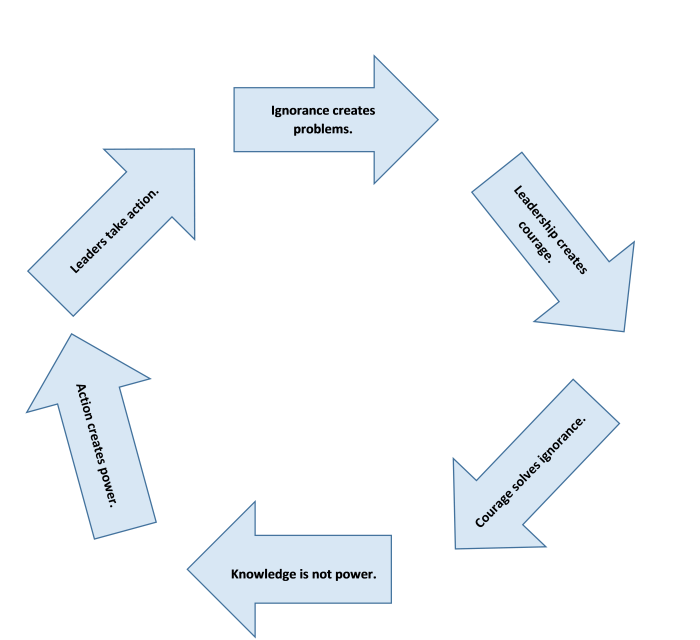
CIT Leadership Initiative Model

  • CITModelIgnorance creates a problem.


An issue or problem exists, but there is no long-term solution. There are Band-Aids applied… there is rhetoric… there are grumbling and grousing… The problem is ignored. The problem may be small and seem small for a while. But that same problem that seems small may grow or fester. An ignored problem does not go away. Labeling a problem other than a problem does not make it a “not” problem.

Look for problems. Never accept there is no room for improvement. Good may not be good enough.

Encourage criticism. LB NT… Liked best… next time…. 5 likes, 2 next times


  • Leadership creates courage.


Leadership, at its core, is action. Leaders have a bias for informed action. A leader finds the ‘problems’ and work to solve them. Usually this involves posing several courses of action and risks— The leader takes one course of action, adjust, refine, correct, & re-act. The care needs to be addressing the real problem… If it (whatever it is) doesn’t improve, ask different questions.

Which comes first? The courage or the leadership? Kind of like the chicken and egg question.

If you don’t like the answer, change the question.


  • Courage solves ignorance.


Courage is the opposite of ignorance. Looking at the problems, asking questions, not settling for status quo, seeking courses of action, taking action, re-evaluating, adjusting action, and paying attention will solve the ignorance issue. This is courage in action. Action is leadership. Leadership will solve ignorance.

There is a fine line between courage and stupidity. Know courage is in short supply. When you display courage you will rise to the top.

Ask for input. Your eyes are only yours. They have fresh eyes… use them too.


  • Knowledge is NOT power.


Sir Bacon Francis, in a book titled Religious Meditations, Of Heresies (1597) wrote “knowledge itself is power”. He was half right. Knowledge without action has little power. To know but not act is true heresy. Francis was commenting on the church and their lack of dogma transparency. In current days, knowledge is common. Almost every human knows how to lose those few last pounds… Eat right, exercise more, don’t eat just before bedtime… It’s not the knowing that makes a difference, it’s the action.

Going to training will NOT improve your CIT program. You must do some work. It’s you… not them.

Your circle of influence expands when you share your knowledge.


  • Action creates power.


There is no substitute for action. Education, knowledge, classes, more knowing… Nothing will outperform taking action. Being the greatest running theorist does not make you a great marathoner. Only running makes you a good marathoner. The universe does not like a vacuum. If there is no positive action, a plot of ground will become weed and vine filled. There is no garden without a gardener. The most knowledgeable gardener must act to get positive results.

Action isn’t a solo act. There are others, just don’t wait for ‘them’ to act. You take action first.

Specify the 3 next steps for your action. Then act. When that’s done, figure your next 3 steps… Then do those… Repeat…


  • Leaders take action.


Because there is no substitute for action, the leader acts. The leader creates personal and positional power by action. This action ensures the one who acts will be essential. Action does creates problems for those who do not act… particularly if they are in positional power posing as a “leader”.   Some positional “leaders” do not act… Action has risks. For instance, you could fail or you could make a mistake. Which leads the circle back to the leadership model where a problem was created by ignorance. The leader never finishes. They adjust, learn, find courage, and act.

Leaders are introspective and take responsibility for their action.

Leaders foster a culture of action (and mistakes). There are zero errors when there is no action.

The CIT Leadership Initiative is a non-profit corporation (503c) for the education and proliferation of CIT Training and community policing.  For further information contact CITLeadership@mail.com 

Of course, your mileage may vary

Dr Jay

I Am a CIT Evangelist

e·van·ge·list/əˈvanjələst/ noun

  • a person who seeks to convert others to the CIT thinking, especially by public exhortation and living the CIT principles.


“Evangelist” is a great ‘tag’ to start because every great idea begins with passionate and great thinking. Great ideas are pushed into being by, change agents or “evangelists”. Evangelists don’t just drink the Kool-Aid, they live it and truly believe in the innovation they espouse.

What separates true evangelists and change agents from the rest of the flock is the intangible fire they possess. Evangelists are willing to bet their political capital and careers on a new ‘disruptive’ process or idea. Evangelists will talk about their project or interests; not just to those interested, but to their colleagues during lunch, their friends when not working, and more.

Evangelists are very persuasive. They are absolutely essential to getting buy-in from the rest of the organization. They are also the ones to convert the first couple of flagship participants. If at least a percentage of your crisis intervention team does not consist of evangelists, the team has a good chance of failing.

Why? Because evangelists conduct themselves like mini-CEO’s. And that’s what you need at a time when roles and responsibilities are still in the process of being defined. You need go-getters, self-starters, and learn-as-you-go people who are willing to put on different hats rather than expect to delegate to an assistant.

Evangelists get their hands dirty. They are not just theorist—they are practitioners. They are willing to work, do, and try. They are willing to show a critical eye, but are also willing to find alternates instead of just criticize.

Only an evangelist can convince a crusty patrol veteran to try a small innovation in dealing with the mentally ill consumer.

Further, evangelists will help you to recruit other strong talent. The intensity of evangelists will probably scare off ho-hum bench-warmers and attract the A-team the big change initiative will need, especially in the formative months.

Years ago one of the men who helped form my world view taught me:

“Everything rises or falls on leadership. Everything.”

And I believed him. He was a true leadership “evangelist”. Dr. Lee Roberson (1909 – 2007), the founder and Chancellor of an alma mater, was fanatically about leadership. And as a result of his fervor, he impacted two generations of leaders.

I am a CIT evangelist. Join the crusade with me, won’t you?

Of course, your mileage may vary…

Dr. Jay

What Can I Trust?

I am haunted by my hospitalist words. It was the next day in the ICU,  after being admitted for my CVA (Cerebrovascular accident).   My doctor spoke with a slight Russian accent.  Her tone was very ‘matter of fact’, like a weather forecast, or like an un-engaged bureaucrat issuing droll hum-drum tax information. She said:

“You’ll never work as a police officer again…. Maybe it’s time you get nice office job”

I was stunned. I thought “you don’t know me”. I was outraged. I was hurt. I couldn’t hear anything else this doctor told me. I insisted that she leave my hospital room. How could this doc know this with such certainty?  I didn’t trust her words.

It’s almost 8 months since she told me this.  I’m still not working as a “real” police officer.  I’m still on light duty.   Her prophecy has slightly cracked my shell and I finally conceded she might be correct.  Last week my speech therapist told me “you’re not progressing as we thought you should have been”.   I still have trouble remembering how to pronounce words.  I can see an object and can identify it, but I cannot remember or say the word to identify the object.   I can’t trust my brain.

I was describing a church pew.  The word “pew” wouldn’t come to my thinking.  I could only remember how to say it when the person I was talking with asked me “pew, right?”  Not that “pew” comes out in conversation very frequently, but it was disturbing I couldn’t remember a word that is this familiar to me.  I can’t trust my vocabulary.

I like to sing.  I’m not a professional singer, but I enjoy it.  I’ve been singing all my life and literally knew the lyrics for over 1,000 songs.  Now I can remember the melody line, but not the lyrics.  This week I spent hours trying to remember the title of our national anthem.  Weird, since I’ve performed “The Star-Spangled Banner” several times.  Now I can remember the title and the opening line — the rest of the lyrics continue to elude me.  It’s frustrating, I can’t trust my memory.

There are more foibles I am unwilling to share in this forum.

I did chat with the city’s disability guru.  She was pleasant, but seemed to know something I wasn’t willing to admit.  She said when I am ready to come back to work it “might not be at the police department”.  Strange she knows more about my possibilties than I know.  I don’t trust the city’s best intentions.

I’ve been very absent writing because it is very hard to write for me right now.  Not the content…. That’s the easy part.  So that I do not sounding like a whiner…. And putting these ideas in readable sentences that make sense…. And not showing my self-disgust for not getting better quickly…. These are the challenges.   I don’t trust my writing.

AFGO— Another freakin’ growth opportunity…. I just don’t trust it….

Of course, your mileage may vary.

Dr Jay Irvin


Guilt by Light Duty

stroke2

Since March this year I’ve been on ‘light duty’ as a police officer.  March 1, 2016 I had a CVA– a stroke– a brain attack.  As CVAs go, this was a mild one.  I was blessed.

Since then I’ve not been working as a uniformed patrol officer.  I’m writing this in late June and will be away from patrol until early October.  I’ve had a lot of time to think.

My current ‘light duty’ assignment is to create/write/develop a curriculum for the Crisis Intervention Team (CIT) for the police department.  It’s a big job and a necessary one.  And I may be the best capable guy to do that… Considering my education, training, and expertise in training.    Originally I was to assist other CIT members developing the curriculum, but the focus changed; then I got the mandate to ‘just create’ the curriculum.

Being on ‘light duty’ is a pariah.  I’ve always had a hard time ‘belonging’ and this makes it harder.  I’ve heard comments such as “How long are you gonna keep gold-bricking?” and “You don’t look like anything is wrong” and “You sound like fine to me” and the best comment– “You must love this not having to be on patrol”.   Patrol staff is always short.  Officers on light duty create more work for the patrolling officers.  I feel guilty.

I don’t have a bandage or a sling or a cast or visible bruising.  My issues that prevent me from working patrol are unseen issues.  My language still isn’t right.  I still have a stammer and stutter.  I still search for correct words.  I still struggle with pronunciation of common words.   My writing is laborious.  I call my mis-speaking and mis-writing as “stroke-isms”.  Humor is best way (for me) to deal with what I’m going through.

My organization has been outstanding. The administration seems to be patient with my recuperation.  And I’m doing that which no-one else wants to do… And I like doing it.

To be a ‘true’ police officer I know I should never admit to liking anything. ‘Real’ police officers bitch and moan and complain about no matter the task.  That doesn’t work for me…. About 30 years ago I decided that I would enjoy whatever I do or wherever I am.

My goal is to enjoy my station in life or work and try to live with grace and patience.  I want to enjoy whatever I do.  I must find the value in my moments and like them.  Of course, to live with grace, I need to leave my ‘guilt by light duty’ behind.  This is a chore for me.

Self-improvement work continues…. doggone it…. Back to my chore.  Like I said, I’ve had a lot of time to think….

Of course, your mileage may vary…..

Dr Jay


Best Laid Plans

stroke2

It’s been a while since I’ve published any articles.  I didn’t plan on being so absent from my blog.   I seem more tentative in writing in my ‘post-stroke’ days.  Sad, really….

I’ve been having more challenges that I want to admit.  I was planning to do some speech therapy and planning go back to my life as normal…. But not so fast, it turns out.  Not so fast at all.

I planned on take the requisite 20-30 light duty days and transition back to my old world. I am a patrol officer for a medium city.  I take my profession serious and my obligation to the public and my organization very seriously.  We are short-staffed and my team needs me.   Apparently I’m sitting out for another month and perhaps more.  The doc said this takes time.

Mentally I think I’m back to the challenge. Verbally I’m not sure.  One of the therapist put a name on it “apraxia of speech”.  The American Stroke Association (ASA) defines it:

Apraxia of speech most often follows a stroke that affects the language-dominant hemisphere of the brain. It is usually associated with damage to the areas of the brain supplied by the left, middle cerebral artery. Apraxia of speech may range in severity from a complete inability to speak to very mild, barely detectable distortions of speech.

For me, usually I know the words I want to say. I understand the language. I recognize them if I read or hear them, I can even spell them. But I can’t remember how to pronounce the word.  This is a real challenge for me.  There are other issues…

I didn’t realize how much losing a large part of my verbalization ability upset my apple cart until one of my colleague told me how she saw it…. She said I as a very articulate communicator and could use words in a way 99% of the world will never have that ability.  “But now since your stroke, you’re having to identify who you are all again…”  Her insight hit me like a Mack truck. I’ve lost my identity.  No wonder she is called “human extraordinaire”.

We have concepts of who we are that give us identity.  I’m a good dad. I am a great cook.  I’m a smart dude.  I can speak in front of crowds. I am a ‘crazy-whisperer’.  And my list goes on.  I’ve identified myself as a great ‘talker’.  Now that identity has been taken; my new identity as stuttering, stammering, can’t-remember-how-to-pronounce-words-guy, and use-the-wrong-word-guy leaves me feeling lost.

The best tool a police officer has is the brain.  The tool that works along with this is the ability to talk.  I’ve avoided numerous violent incidents by effective verbalization.  I’ve diffused hundreds of possibly negative issues by talking.  The best negotiators are able to verbalize and communications alternatives and better solutions.  This is Police 101.  And my tool is damaged.   The ASA said it make take 6-12 months (if ever) to get the abilities back to pre-stroke abilities.  Rats to my plans…

And there’s another wrinkle….PBA (pseudobulbar affect)...  This isn’t all that common (about 38% of stroke survivors have symptoms).  It is a condition associated with strokes, TBI (traumatic brain injury), MS (multiple sclerosis), or other neurological issues. The result: sudden, unpredictable crying, laughing, or other emotional episodes that can be disruptive and embarrassing.  And I found about it by mistake. These are not good traits of a street cop.  I have my work cut out for me.

One of my fear is I won’t get back to pre-stroke abilities.  This scares the crap out of me.  No matter of your best laid plans, sometimes else will change ones trajectory…I guess it really is true…. I’m not in charge. I know I’ll do my part to heal and I’ll just hang on for the ride!

Of course, your mileage may vary.

Dr Jay


More Uncertain Times

I’ll let youncertaintyu in to a secret.  I know there’s something I’m supposed to write, but I almost never know what I’m writing about until the article comes out.

That seems weird.  I should know my writing content, but it seldom works that way.  I usually think I know where it’s going … But I’m usually surprised in some ways.

This has been a trying time for me for the last 3 weeks. During this period time I have become re-connected with my mortality.  The stroke took more from me than I am willing to admit.  And it gave some things to me too.

Since my stroke I’ve been struggling with linguistics and language.  I know the word I want to use… But I can’t remember how to say it.  I’ve become facile in finding an analog word.  It took me ten minutes to figure how to say “inoculation“.  I know the word. I understand the word.  I can even spell the word, but there is a part of my word processing brain isn’t working like it used to.  I have to learn again.

Bringing the word to my consciousness is moving slower than it used to.  I was trying to give an example two days ago and struggled to bring the cognitive thoughts so I could create the example.  I know the idea, but the words wouldn’t come.  I couldn’t remember how to verbalize my ideas.  Very frustrating.

Before my stroke I’d never stuttered or stammered.  Now I’ve found some new stammering and stuttering ability.  As a guy who was one of the top of the top professional speakers, this is new territory.  It is scary.

As long as I can remember, I’ve been one of the quickest, smartest guys in the room.  I’ve been in the top 3-4% of ability to cognate, think, verbalize, and communicate.  It was a gift that was natural; it was easy for me. I got a 3.98 GPA in under-grad school (I made a B+ once); I made all A’s in grad and post-grad work.  I was the classic over-achiever/nerd.

My humor is still good, but I can’t get the joke out with any effective timing.  Trying to joke reminds me of the classic horrible joke tellers I knew… Now I am one.

My decline of my abilities has taken a toll on my confidence.  Or it’s made me more human.  Or both.  I’m in new un-charted waters again.  The medico says there is nothing “permanent” damage.  They’ve said I’ll have to practice and learn and push it to get my linguistic abilities back.  It’s slow.

I was in a promotion process 20 days later after my stroke.  Some of my confidants advised me to “sit out” this round.  Some were encouraging.  I considered recusing myself.  I’m glad I went through the process.  And I learn some things.

Going through the process wasn’t pretty.  I stammered, searched for the right word, sounded too emphatic at the wrong time, and didn’t complete ideas I presented.  It seems like my ability to lucidly present an idea disappeared in a moment.  Poof!  Needless to say I was not selected… And rightfully so.

And like I said there were some gifts….

My docs have given up on my eating patterns. They didn’t suggest changing diet or losing weight.  They decided more medication was the best route (this isn’t the gift).  But my eyes are more wide open than ever.  On my decision I’ve radically changed my diet.  I have not had any refined sugar since getting out of the hospital.  This has NEVER happened to me.

My name is Jay and I’m a sugar-addict.  Recovering.  For me, my white powder drug of choice has always been sugar.  Yes, I might of killed a few people in the way, but the process of becoming sugar-free may be one of the greatest things I can do for myself.  I’ve been sugar-sober for 21 days.

According to the BMI (body mass index) I am considered overweight until my weight drops below 199 pounds.   When I just finished OTS (US Air Force Officer Training School) I was about 200 pounds at 27 years of age.  That was 60 pounds and almost 30 years ago.  At my fattest I was 320 pounds.  When I was admitted to the hospital I was about 260.  Now I’m 234 and dropping.  My goal is 199.  Yay, goals.

My title means life isn’t certain.  When I think I know about the “zig”–Life gives me a “zag”.  I do lived a blessed life…. And as I’ve read and said… “I’m Not in Charge“.

Of course, your mileage may vary

Dr Jay

What’s Your Purpose?

I guess the question of “What’s Your Purpose?” came to my mind because I caught myself doing things out of habit instead of on purpose.  I know you can do just about anything you set your mind to if you have strong enough motivation… If you have a strong enough purpose….

With that in mind, I decided to cut back my refined sugar intake–My purpose in reducing my sugar consumption is to:

  • live longer
  • be healthier
  • control my diabetes better
  • drop a couple of inches from my waistline
  • improve my energy and
  • promote other health benefits I can’t even think of

But I sabotaged my purpose through an unhealthy habit.  This came to my conscious awareness just after I popped a piece of left-over Valentine’s chocolate into my mouth…. An unconscious behavior…. a habit… after a healthy meal!

For years I’ve publicly stated that my white powder drug of choice is sugar. My sugar habit is akin to a smoker lighting up…. I didn’t even think about what I was doing until the creamy chocolate truffle was melted in my mouth…. Geez what’s wrong with me?

Freud would say my purpose wasn’t properly internalized…. Therefore I didn’t behave in a way consistent with my stated desires…. My ID just beat my EGO and my SUPEREGO laughed in judgement.

Jung would say my Self was overcome by my shadow — Or the personal unconsciousness of the whole which encompasses the compensating values of the dark side or trickster archetype.

Erikson would simply question “Was it OK to have been you?” (In a German accent of course)

Ellis would reinforce that I never knew my truest beliefs about myself and was doomed to eat the chocolate until I adjusted my unknown beliefs.

Rogers may hypothesize that the apparent in-congruence of a fully functioning person is because of my lack of openness to the experience.

Skinner would remind me that my freewill to not eat sugar was just an illusion.

Or maybe I set myself up for failure?  I am the one who left the candy in my candy drawer.  And I have a CANDY DRAWER!

Perhaps I wasn’t honest with myself?  If I really intend to cut sugar out then why do I have a stash?  Hmmmmm…. Honest self-introspection isn’t always fun.  Dr Jay the behaviorist makes a diagnosis of Jay the sugar fiend.  Behavior betrays motivation…. Again.

But this isn’t just about candy.  It’s about everything in life.  Is my stated purpose aligned with how I’m living my life?  What is my stated purpose?  Am I setting myself up for success in that purpose? What is my vision? What are my real goals? How do my stated goals match up with my behaviors?

Are my organizational goals aligned with the behaviors at work?  We say we want compassion… Do we take the time to show it to our citizens?   We say we want community policing… Do we make the effort to engage them in our responses?  So much room for growth!

Perhaps this isn’t you. Maybe you, your purpose, your goals are congruent and aligned.  I hope so!  But I’ve got work to do….

And of course,  Your mileage may vary!

Dr Jay


Live Like You Were Dying Pt 1

This is an excerpt from my book “How to Live Like You Were Dying: Notes from a Cancer Survivor”        Originally written in 2005.

llywdying

Chapter One

 
“O death, be not proud” from Sonnet X, Jon Donne

 
For most of us, the good news about dying is that we don’t know when it’s going to happen. We don’t know when we are going to die. And for most of us we don’t use the term “good news” and dying in the same sentence, but I’m getting off point.

For most people when the idea of passing away comes up, ignorance is bliss. Psychologists call it denial. To me, it was just the way I lived. For me it was normal.

I never thought much about dying. I certainly didn’t worry about it. I certainly never considered writing about dying. Happily, this isn’t about dying. It’s about how to live. It’s about how I learned to live based on circumstances in my life. It’s how you and I might live better if we have an awareness of our mortality.

On the rare occasion I thought about the possibility of dying I didn’t think it would be my turn soon. I often joked that I wasn’t afraid of death… I just didn’t want to be on the next bus load. I laughed when other people joked about dying; the old joke that they didn’t mind death, it was the dying that was a nuisance. In short, I didn’t make much space in my thinking for mortality, death, or dying.

But who does? Certainly none of the people I knew or associated with did. We were macho. We were immortal, or so we thought.

I only casually thought about death when I brushed past it in my life. A long-time loyal bar customer had an unexpected heart attack and I said a few words at the eulogy. A cherished employee passed from AIDS related disease and I told him “Thanks & Goodbye” in the hospice. A student friend had gotten killed in an automobile accident and it was a shock.

My best friend from grade school was killed in a motorcycle wreck, but with his reckless life, I kind of expected it. Even my father had passed away years before from heart disease near age 69. But I was unfazed; he was in poor health and had heart disease.

I never considered my mortality. As I moved from my 20’s to 30’s and into my 40’s I felt my body change. I got tired easier, I got heavier. I got “soft”. Some would say my body was deteriorating and there’s a medical argument for that, but I never considered the possibility that I could be dying. I never considered that I could be dying soon.

It was a big shock when my oncologist diverted her eyes from mine on our first office visit and told me at best, I had six months to live.

SIX MONTHS? That’s only 180 days. How could she give me this “death sentence” with such certainty? How could she not look me in the eyes when she said this? What was so important on that paper that she had to look at it when she delivered this shocker to me?

I was shocked. I was in disbelief. The doctor had to have made a mistake. I didn’t feel like I was dying.

After all what kind of credibility could she have? She had a bad hair color and dandruff! Her hair was a little greasy and unkempt. There were dandruff flakes on her shoulders. Her roots didn’t match.

Here was a medical doctor, an oncologist, a trained professional giving me devastating news and I was focusing on her personal grooming habits and lack of style! It’s amazing what tricks the mind can play when one gets such shocking news. I was getting the worst possible news in my life and I was criticizing my grim reaper’s lack of élan.

I was judging her for letting her roots show, so that I barely heard the “death sentence”.

Of course your mileage may vary.

Dr Jay

Servant Leadership

Servantleadership

I was looking through some leadership and management lesson plans from 10 years ago.  I wasn’t just strolling down memory lane….I was on a mission.  My sergeant (knowing my teaching history) asked me to send some leadership/supervisory training material to her.

My sergeant is doing a great job (from my perspective), particularly for a first year supervisor.  And when, as a boss you wanna learn more, this is a good thing.  But I digress.

As I looked through my old work, I was reminded of some leadership fundamentals that I just take for granted.  I assume everybody knows what I know.  The truth is good leadership can be a scarce commodity.

To me the definition of leadership is simple:

Leadership = Influence

I know there are many more complex definitions of leadership, but I think there is more profundity in simplicity.  Either that, or I’m just a simple guy.

Reading back over my teaching notes and looking at my slides I see an obvious connection between attitude and leadership.

So you know, I define attitude as:

The perspective or lens you use to view the world.

Here’s the slide that jumped out at me:

ParadigmDifferences

I know effective leadership is “Esteem based” not “Ego based”, yet how many times do I let my ego get in my way of being effective?  Don’t answer, it’s too many times.

It happened recently. I didn’t feel supported in an issue at work this week (Not involving my sergeant, to be clear).  As I worked through the issue, I know I wasn’t as effective as I could have been because I had a ‘need to be right’.  My ego got in the way.  Good thing I’m still learning and growing as a human….

When I was about 16 or 17 years old a boss told me “To be a good leader you must have a big ego”.  In hindsight, I think he was just trying to justify his huge ego because he was the boss.

I think what my slide really refers to what is called ‘servant leadership‘.  It’s the opposite of ‘power driven’ leadership.

I’m no expert, but I know it when I experience it.  And I hope it’s something I demonstrate it on occasion.   It’s a living example of Ziglar’s “You will get all you want in life, if you help enough other people get what they want”.

Servant leadership requires working for the greater good.  As a public servant I know this.  Now if I can only live what I know!

Of course, your mileage may vary.

Dr Jay

Why Failure is Good

FailureChinese

Failure can be good for you.  I should know… I’ve done my share of it.

I didn’t always think this way.  I used to judge life by the success I achieved.   I even changed my definition of success  so I could enjoy more success and not have to admit my failures.

“If I learn something from any situation, the learning itself is a success”.       I told myself.

Because I decided to learn something from every situation I didn’t experience much I defined as “failure”.    And I may not have had the growth opportunities associated with failure.

Here are some of my “failures”:

I failed to retire from the US Air Force.  I served 12 years I only had 8 more years of active duty to retire.  Had I done that I would have a pension and health care for life.  Sure, I learned… but not getting a military retirement is a failure.

I failed to stay married.  I’ve been divorced twice.  Yep, I learned a lot from divorce…. But they were still painful…. And I think there are better ways to learn.

I never became a famous chef/restaurant owner.  I got out of the military and pursued my big dream.  I was gonna be the next Emeril Lagasse.   I opened a series of restaurants. I did well in my restaurants.  I earned over a million bucks a year.  And I had some local notoriety.  But my TV and cookbook deals never came.  I couldn’t even get Diners, Drive-Ins, & Dives to come to my last joint….. And of course I learned….

I was a professional speaker, making a living talking and training.  I wrote a couple of books…. I even contracted as an adjunct college professors…. But I didn’t sustain my business after 9/11.  I packed it in and re-branded myself as a therapist.

I found some success as a therapist…. but the economic downturn “accelerated my learning” and I moved on….

Now I’m a street cop.  I was rejected for the first six additional duties I applied for.  The rejection is a great learning tool, but in reality I failed to accomplish what I wanted to accomplish.  Yep… life is full of failures. And so am I….

I’ll tell you what failure is not:

  • Failure is not avoidable.

Failure is not something to be avoided. Denis Waitley says it’s “Fertilizer for success”.  No true success comes without significant failure.

  • Failure is not an event.

Failure, like life and success, is a journey.  There is not one defining circumstance that spells “failure” or “success”.  As long as we continue we have not failed.

  • Failure is not the enemy.

In fact, I’d recommend making failure a friend.

  • Failure is not irreversible.

One of the biggest failures in retail happened in 1985 when Coca-Cola changed the 99 year old recipe for Coke.  Consumers hated it. It only took the company 77 days to bring back and re-brand “Classic Coke”.   The executive that created the fiasco was fired.  And then re-hired  a few years later.

  • Failure is not final.

Failure is only final if you quit.

  • Failure is not a stigma.

Rather, I should say “Failure should not be a stigma”.  FedEx founder Fred Smith told about one of his execs making a $300,000.00 blunder in the early days of the fledgling overnight company.  The executive came in prepared to resign his position after the failure came to light.  Fred wouldn’t accept his resignation.  Fred said “No way I’m losing you, I just invested $300K in your education”

  • Failure is not the goal.

Although I’m coming to grips with the ups and downs in my path, I’m not on the hunt for my next “failure”.  What I do know is that the only person who doesn’t make mistakes (fail) is the person who doesn’t do anything.  And I’m not that guy.

Of course, Your mileage may vary.

Dr Jay