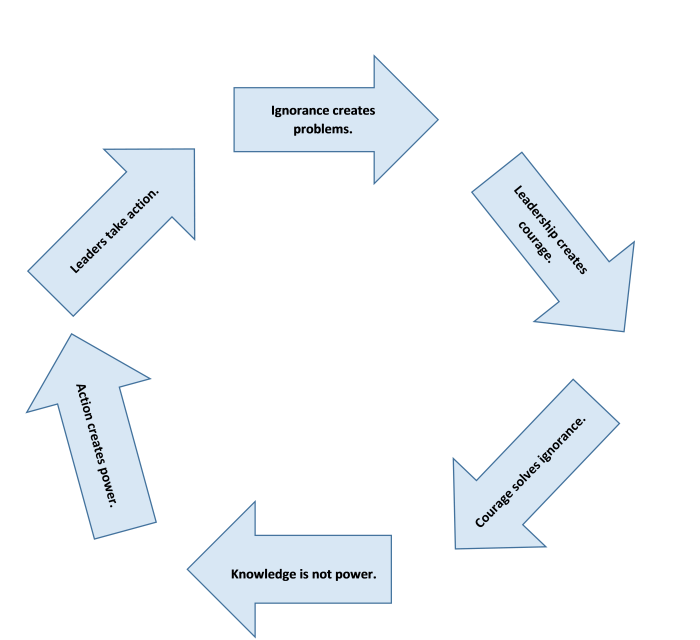
 Ignorance creates a problem.
An issue or problem exists, but there is no long-term solution. There are Band-Aids applied… there is rhetoric… there are grumbling and grousing… The problem is ignored. The problem may be small and seem small for a while. But that same problem that seems small may grow or fester. An ignored problem does not go away. Labeling a problem other than a problem does not make it a “not” problem.
Look for problems. Never accept there is no room for improvement. Good may not be good enough.
Encourage criticism. LB NT… Liked best… next time…. 5 likes, 2 next times
- Leadership creates courage.
Leadership, at its core, is action. Leaders have a bias for informed action. A leader finds the ‘problems’ and work to solve them. Usually this involves posing several courses of action and risks— The leader takes one course of action, adjust, refine, correct, & re-act. The care needs to be addressing the real problem… If it (whatever it is) doesn’t improve, ask different questions.
Which comes first? The courage or the leadership? Kind of like the chicken and egg question.
If you don’t like the answer, change the question.
- Courage solves ignorance.
Courage is the opposite of ignorance. Looking at the problems, asking questions, not settling for status quo, seeking courses of action, taking action, re-evaluating, adjusting action, and paying attention will solve the ignorance issue. This is courage in action. Action is leadership. Leadership will solve ignorance.
There is a fine line between courage and stupidity. Know courage is in short supply. When you display courage you will rise to the top.
Ask for input. Your eyes are only yours. They have fresh eyes… use them too.
- Knowledge is NOT power.
Sir Bacon Francis, in a book titled Religious Meditations, Of Heresies (1597) wrote “knowledge itself is power”. He was half right. Knowledge without action has little power. To know but not act is true heresy. Francis was commenting on the church and their lack of dogma transparency. In current days, knowledge is common. Almost every human knows how to lose those few last pounds… Eat right, exercise more, don’t eat just before bedtime… It’s not the knowing that makes a difference, it’s the action.
Going to training will NOT improve your CIT program. You must do some work. It’s you… not them.
Your circle of influence expands when you share your knowledge.
- Action creates power.
There is no substitute for action. Education, knowledge, classes, more knowing… Nothing will outperform taking action. Being the greatest running theorist does not make you a great marathoner. Only running makes you a good marathoner. The universe does not like a vacuum. If there is no positive action, a plot of ground will become weed and vine filled. There is no garden without a gardener. The most knowledgeable gardener must act to get positive results.
Action isn’t a solo act. There are others, just don’t wait for ‘them’ to act. You take action first.
Specify the 3 next steps for your action. Then act. When that’s done, figure your next 3 steps… Then do those… Repeat…
- Leaders take action.
Because there is no substitute for action, the leader acts. The leader creates personal and positional power by action. This action ensures the one who acts will be essential. Action does creates problems for those who do not act… particularly if they are in positional power posing as a “leader”. Some positional “leaders” do not act… Action has risks. For instance, you could fail or you could make a mistake. Which leads the circle back to the leadership model where a problem was created by ignorance. The leader never finishes. They adjust, learn, find courage, and act.
Leaders are introspective and take responsibility for their action.
Leaders foster a culture of action (and mistakes). There are zero errors when there is no action.
The CIT Leadership Initiative is a non-profit corporation (503c) for the education and proliferation of CIT Training and community policing. For further information contact CITLeadership@mail.com
Of course, your mileage may vary
Dr Jay
 We're All Just Tourists