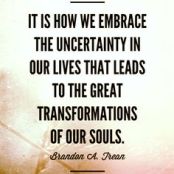
More Uncertain Times

I’ll let youncertaintyu in to a secret.  I know there’s something I’m supposed to write, but I almost never know what I’m writing about until the article comes out.

That seems weird.  I should know my writing content, but it seldom works that way.  I usually think I know where it’s going … But I’m usually surprised in some ways.

This has been a trying time for me for the last 3 weeks. During this period time I have become re-connected with my mortality.  The stroke took more from me than I am willing to admit.  And it gave some things to me too.

Since my stroke I’ve been struggling with linguistics and language.  I know the word I want to use… But I can’t remember how to say it.  I’ve become facile in finding an analog word.  It took me ten minutes to figure how to say “inoculation“.  I know the word. I understand the word.  I can even spell the word, but there is a part of my word processing brain isn’t working like it used to.  I have to learn again.

Bringing the word to my consciousness is moving slower than it used to.  I was trying to give an example two days ago and struggled to bring the cognitive thoughts so I could create the example.  I know the idea, but the words wouldn’t come.  I couldn’t remember how to verbalize my ideas.  Very frustrating.

Before my stroke I’d never stuttered or stammered.  Now I’ve found some new stammering and stuttering ability.  As a guy who was one of the top of the top professional speakers, this is new territory.  It is scary.

As long as I can remember, I’ve been one of the quickest, smartest guys in the room.  I’ve been in the top 3-4% of ability to cognate, think, verbalize, and communicate.  It was a gift that was natural; it was easy for me. I got a 3.98 GPA in under-grad school (I made a B+ once); I made all A’s in grad and post-grad work.  I was the classic over-achiever/nerd.

My humor is still good, but I can’t get the joke out with any effective timing.  Trying to joke reminds me of the classic horrible joke tellers I knew… Now I am one.

My decline of my abilities has taken a toll on my confidence.  Or it’s made me more human.  Or both.  I’m in new un-charted waters again.  The medico says there is nothing “permanent” damage.  They’ve said I’ll have to practice and learn and push it to get my linguistic abilities back.  It’s slow.

I was in a promotion process 20 days later after my stroke.  Some of my confidants advised me to “sit out” this round.  Some were encouraging.  I considered recusing myself.  I’m glad I went through the process.  And I learn some things.

Going through the process wasn’t pretty.  I stammered, searched for the right word, sounded too emphatic at the wrong time, and didn’t complete ideas I presented.  It seems like my ability to lucidly present an idea disappeared in a moment.  Poof!  Needless to say I was not selected… And rightfully so.

And like I said there were some gifts….

My docs have given up on my eating patterns. They didn’t suggest changing diet or losing weight.  They decided more medication was the best route (this isn’t the gift).  But my eyes are more wide open than ever.  On my decision I’ve radically changed my diet.  I have not had any refined sugar since getting out of the hospital.  This has NEVER happened to me.

My name is Jay and I’m a sugar-addict.  Recovering.  For me, my white powder drug of choice has always been sugar.  Yes, I might of killed a few people in the way, but the process of becoming sugar-free may be one of the greatest things I can do for myself.  I’ve been sugar-sober for 21 days.

According to the BMI (body mass index) I am considered overweight until my weight drops below 199 pounds.   When I just finished OTS (US Air Force Officer Training School) I was about 200 pounds at 27 years of age.  That was 60 pounds and almost 30 years ago.  At my fattest I was 320 pounds.  When I was admitted to the hospital I was about 260.  Now I’m 234 and dropping.  My goal is 199.  Yay, goals.

My title means life isn’t certain.  When I think I know about the “zig”–Life gives me a “zag”.  I do lived a blessed life…. And as I’ve read and said… “I’m Not in Charge“.

Of course, your mileage may vary

Dr Jay

Do Be Have

BeDoHave2

Years ago I uncovered an idea…. The Do-Be-Have model.  I always thought it was something that came to me out of my consciousness, but I’m sure I heard or read it somewhere.

This was pre-internet. This was when real ink and paper books mattered. I was a voracious reader then (1-2 books a week). I was a military officer (Captain in the US Air Force) and was writing intermittently.

I was going to write a major self-help/pop psychology book.  My working title was:  3 Realities of Life.  I even had a concept for the cover art.  It was about this time (mid/late 1980’s) that the Do-Be-Have model percolated to my mind.  It was Part I of my book.

In short, the Do-Be-Have model is about who we are and how we see ourselves.  It’s about self-identity…. paradigms….the lens you use to view the world.

In Western culture very often we identify who we are by what we DO.  This is the essence of a business card.  And the perennial question at a dinner party…. “So, what do you DO?”  We summarize what we do in one statement.  I’m a street-cop. I teach kids. I work for Intel. I’m retired. I’m a golfer….

The other way we often identify who we are is by what we HAVE.  “I have a doctorate” (I HAVE a college degree) or “I’m a mother” (I HAVE children).  Or I’m a home-owner or I drive a Mercedes or I have cancer or I am a blonde….

Very seldom do we identify ourselves by what we BE.  The essence of humanity is to exist.  We just are.  One of the challenging assignments I have given my classes over the years is to describe oneself by “who you BE”…. without referring what you have or what you do.  Try it… it’s challenging.

If we figure out first who we are (BE) then we can decide what we want to HAVE  (goals, aims, directions) and combine those (Be+Have=Behave).  Behave tells us what to DO.

In our culture we have the order backwards.  We DO first, then figure out what we want to HAVE and usually never worry about BE until a crisis hits.  If we decide we want to HAVE more, we DO more.  This is an illusion, but DOing is limited.  BEing is not limited.  The truth is if we BE more our HAVE will increase.

Part I of the book was Do-Be-Have ….. in great detail.

Part II was the 3 Realities… They are:

  • Reality… The way the world really is… Independent of your bias or mine.  True reality.  No spin.
  • Industreality…. The way the world works.  Girls do this; boys do that.  There is “black or white” “good or bad”. The world of implicit and explicit biases. The why-everything-works-as-it-does reality.  The reality of limitations. Why a runner can’t break a 4 minute mile barrier.  Why carbon based fuel is the future. And other “rules” that will consistently be broken by innovative thinkers and do-ers.
  • Surreality…. The reality of the imagination.  This is the only way to achieve dreams that are worth.  The ability to act “as if” and move through industreality into a new reality that you have created.  This is what Thoreau wrote about.

Part III was how to implement these ideas into practice and move from Industreality to your own Reality.

I haven’t written the book (yet).  I did, however, live the 3 Realities of Life.

I moved from my Industreality of violence and sexual abuse as a child: to my reality of protecting the abused and prosecuting the abusers.

I moved from the Industreality of my family of origin issues; to my reality of having  great family.

I moved from the Industreality of being diagnosed with ‘terminal’ cancer with six months to live; to my Reality of becoming cancer-free five years later.

I moved from the Industreality of losing my health, my job, my family, my business, going bankrupt, and being told “you’re too old”; to my Reality of becoming a street-cop at age 50+.

Maybe I will write that book… maybe…

Of course, your mileage may vary.

Dr Jay

Love Thyself

IloveYou

I’ve prescribed a small seemingly silly exercise to dozens of past therapy clients.

It’s an “I love me” exercise. I coach the client to look into a mirror and say “I love you” to themselves aloud. The instruction is to say “I love you” three times while maintaining eye contact with themselves in the mirror.  When they repeat “I love you” they place emphasis on a different word each time they use the phrase.

  1. I love you”
  2. “I love you”
  3. “I love you

Yeah, I know it may seem cheesy.  And maybe it is, but I have never had a client deny there was value to this exercise.

Loving one’s self is a challenge for most people.  Most of us have heard things like “He’s too big for his britches” or “She has an awfully high opinion of herself” or “I wish I could buy him for what he’s worth and sell him for what he thinks he’s worth.”  We’ve been indoctrinated to not love ourselves.

We’ve definitely been indoctrinated not to say “I love you” to ourselves.  We usually think it’s only correct to hear it from another person.  This is not true.  We need to hear it, feel it, and understand self-love, independent of the good opinion of others.

If you begin this practice it may be uncomfortable.  If your loved ones see you doing this, they may question your sanity.  Talking out loud to one’s self is usually suspicious.  When you feel more comfortable with the exercise you can ‘up the ante’. Try this, stand in front of a full length mirror while you’re naked and say “I love you, ALL of you”.  Of course you’ll wanna do that one in private…. Being naked at the mall is definitely frowned upon.

Most clients who stay faithful to this practice notice some internal dialogue shifts within themselves. Personally when I was first coached to try this (about 20 years ago) I noted more smiling at my foibles instead of berating myself for goofy antics.

A minor shift in internal dialogue does not seem like a big deal…. But it is.  If you’re like most of us, you are the harshest critic you have.  This harsh silent internal self-criticism has a devastating cumulative effect.  Release the self-criticism and replace it with self-love.

Most of us can identify our objects of affection easily…. We love our spouses, our kids, our pets, our jobs, even our vehicles.  We love a favorite meal or restaurant.  We love our sports teams. We love a favorite vacation spot.  We love TV shows and sometimes even well-written or acted characters in those shows. We love and idolize stars and actors we do not know. We love music of a particular genre or era.  We love many many things…. Add one more conscious object of affection.  YOU.  Remember to Love Thyself.

Of course, Your mileage may vary.

Dr Jay

Who is Your Hero?

“A hero is no braver than an ordinary man, but he is brave five minutes longer.”

Ralph Waldo Emerson

As a culture we’ve confused celebrity with heroism. We’ve confused fame with nobility. I am saddened by this thinking.

Being considered a hero used to mean you had to have accomplished something that was significant or contributed to society.  You walked on the moon (Neil Armstrong) or led civil rights (Dr King) or averted a nuclear war (Cuban Missile Crisis, President Kennedy) or explored and developed new areas (Daniel Boone) or led an expedition (Lewis & Clark) or conquered the highest mountain (Edmund Hillary) or did something.

Today, most of the celebrity “heroes” are music moguls or athletic stars: They are entertainment figures. I believe music and sports have a place in culture and there are notables in both fields.  Some notables are iconic…. But not heroes. They are famous… But not heroes.  They have celebrity, but are not heroes.

I guess it all comes down to your definition of “hero” or “heroine”.   The generally recognized definitions of hero are: :

  • a mythological or legendary figure
  • one admired for great courage or noble qualities
  • an object of extreme admiration and devotion

The word “hero” comes from Greek “heros” meaning demi-god.  A demi-god is one who isn’t quite a god yet, but has more power than a mere mortal.  To be clear, I’m using the term “hero” which is the masculine form.  “Heroine” implies the same, but in feminine form.  “Heroine” was first used in c.1650.

Webster’s first definition seems to fit the form of demi-god.  Persons held in mythological stature (sometimes fables) from embellished stories passed through generations (Paul Bunyan, Johnny Appleseed, Robin Hood). Or “super-hero” fantasy characters (Superman, Bat-man, etc.)

For me, the second definition is the one that resonates.  Those people who demonstrate courage or bravery and maintain noble qualities (9/11 responders, combat veterans, those working to help less fortunate: nurses, firefighters, police officers).  These are the people that very seldom become famous but continue to do a difficult thankless job in spite of the lack of rewards.

A real hero is a mom who continues to “do the right thing” even when the no-good dad is nowhere to be found.  A real hero is the teacher’s aide who gives a hungry child a snack from her personal lunch stash.  A real hero is the anonymous citizen who shepherds a lost child until the child is safe.  A real hero is the Average Joe giving CPR until medics show up.  A real hero doesn’t have anything to do with popularity or celebrity.  Most heroes are the unsung ones.

I met a couple of real heroes yesterday.  I had the honor of helping at a fund-raiser for Special Olympics.  There I met a  married couple who happened to be corrections Captains. They have been volunteering for this charity for nearly two decades. Yesterday they spent a 12 hour unpaid Saturday helping make dreams come true for the less fortunate.  They are real heroes, yet there were no TV cameras or media blitz.  They did it because of their noble ideals.

The last definition of heroism is probably the most popular and disappointing (to me).  Idol-worship.  Fame based heroism.  I threw up a little in my mouth when I typed that.  Some celebrities rebel against this archetype– (“I am not a role model”- Charles Barkley).  However most celebrities revel in the hyperbole and believe the hero worship.

I don’t think I’ve ever understood our national fascination with celebrity.  I can’t identify the Kardashians out of a police line up. I think this has to do with my upbringing.  I grew up without television.  My mom was a religious nut and thought TV was evil.  She was serious about it.  My sister and I were not allowed to watch TV at friend’s houses and we were trained to turn away from televisions when we saw them on display in a department store.  Weird, huh?

There were some good side effects from growing up without TV.  I became a prolific reader.  I learned to listen and talk with anybody. I never idolized sports figures nor TV celebrities. The people I held in esteem as heroes were ones I met through our social circles (Lester Roloff, Fred Sink, Joe Hege) or ones I read about (Charles Lindbergh, Amelia Earhardt, Harry Truman, Apostle Paul, Lincoln, Gandhi, Da Vinci, Shakespeare, Newton, Helen Keller, and the list goes on).

But this isn’t about me.  This is about how we as leaders can effect positive change in our circles of influence. How can we create a shift away from idol worship to true heroism?  Here are some ideas:

  • Set the example. Know your own heroes.  Make your ‘walk’ congruent with your ‘talk’
  • Look for unsung heroes and acknowledge/reward them. What gets rewarded get repeated.
  • Teach values other than becoming famous or popular.  Realize social media “likes” or being popular aren’t good indicators of character or nobility.
  • Know good character is a developed trait. More practice makes better character.  Build yours and theirs.
  • Recognize every real-world hero is human and fallible– They make mistakes AND may still be heroic.  Just because you make mistakes doesn’t necessarily make your actions less heroic. (Think heroic effort)
  • Understand “anti-heroes” and learn why we like them (Bonnie & Clyde, Sopranos, Blackbeard)

Psychologically we need heroes. They give us inspiration and help us aspire to our “higher selves”. And we will find heroes… Consciously or not.  It’s better to make your heroes ones you choose, not ones the media or your boss or your social circle chooses for you.  You are in charge of your own narrative. You can live the life you’ve imagined!

Of course, your mileage may vary.

Dr Jay

I’m Not in Charge

Jack Canfield was the guy who made Albert Ellis easy to understand for me.

Jack is the Harvard educated author, motivational speaker, and seminar leader who co-created the Chicken Soup for the Soul series of books.  Jack started as a high school teacher and co-authored a book for high school teachers on ways to develop self-esteem in students. He successfully marketed his book in the National Enquirer and created his first fortune by sheer will-power.

I met Jack Canfield in 1993 when I was contracting for a major training company.  Jack was hired as the “big gun” speaker for our annual conference.  It was a joy to meet him.  Jack taught a very simple equation for success and happiness—

E  +   R    =   O

Event plus Response equals Outcome.

Event– Things in life we have no control over (bosses, weather, kids, customers, everything external to us)

Outcome– What happens in life. (Results, your life, the end, success or failure)

Response– The only thing in life over which we have control.

Jack’s bottom line is this:

If you want better results (outcomes) create better responses, because you can’t change events. (You’re not in control of ANYTHING except your response… get used to it)

Albert Ellis was a Columbia University PhD in clinical psychology.  Albert Ellis’ REBT is probably the most influential psychological concept present in the therapy community today. In a poll of psychologist and therapists Ellis was ranked as #2 All Time Most Influential Psychologist right behind #1 Carl Rogers and ahead of #3 Sigmund Freud.

Ellis died in 2007 and published over 60 books.  Most of his works were written for PhD students and practicing clinicians.  He attempted to make his theories easy to understand. That didn’t work.  He developed the ABC of REBT (rational emotive behavior therapy).

To understand ABC of REBT you need a PhD or JD or LLD or Lucky Charms decoder ring or a really patient professor.

A = Activating Event (things that happen)

B = Belief System (hidden from view)

C = Consequence  (results in life)

Ellis said we often make decisions about things in an irrational thinking style and don’t get the consequences we want because of mistaken beliefs (that we don’t know or can hardly understand).  I’m paraphrasing, of course.

In short:

You’re not in control of anything except your belief system, which you don’t understand. 

Both scholars are essentially saying the same thing:

There is very little we control in life. Control over external things is an illusion.

I bring this up because this weekend I forgot what I know.  I forgot to “Let it Be Easy”.  I still think I can control the world.  I can’t.  I’m not in charge.  I’m only in charge of my response and belief system.  That’s it.  Nothing else.

I’m not advocating an abdication of responsibility… I don’t believe some sort of hyper-Calvinism that says all the world is predetermined and predestined and “whatever will be will be”. I’m suggesting that I must recognize what I do have control over and manage that effectively.  When I get control of my responses and what I believe, I’ll have reached more success than I can imagine!

I guess my mistakes keep me grounded in my humanity and work to keep me humble…. Learn. Grow. Teach…. Where have I heard that before?

Of course, your mileage may vary.

Dr Jay

Let it Be Easy

easybutton

I’ve been writing pithy vignettes with learning or growth insights for more than 10 years.  I have no idea if they’re valuable to anyone other than me.

The narcissist in me wants to believe it’s all about me, of course.  They ‘way-shower’ part of me thinks it’s about leading others.  The father in me thinks it’s about legacy.  The therapist part of me thinks it therapeutic.  The rigid disciplinarian thinks it’s about the regime and the discipline it takes.

My wife told me “That stuff sure comes easy to you”.   I bristled when she said that. I’ve never felt that way.  Ease wasn’t part of my vernacular when it came to writing.  The Puritan ethos I absorbed as a child placed more value on “hard work” and “working for what you earned”.  Easy was almost a dirty word.  I didn’t value what “comes easy”.

There are things that “come easy” to me.  I can stand in front of a crowded room and speak with almost no effort.  I can visualize building projects without blueprints.  I have a good ear for music and language.  I can easily distinguish Spanish from Portuguese (and I speak neither).  I can create conversation with almost anybody.  Cooking with no recipe is easy for me.  Still, I don’t value that which “comes easy”.

Ten years ago I went to an advanced hypnotherapist training (then located in Santa Fe, NM). I’d never studied existentialism in much detail.  There, at the Academy, I spent six months of 40 hour weeks immersed in new thought, yoga, meditation, humanistic existentialism, clinical practice, and “hypno-thinking”.  It was good for me.

I remembered a meditation/hypno session with one of my instructors.  The theme was “walking through open doors”.  The sub-theme was “let it be easy”.   The lesson was that doors open and we walk through them with little effort.  There are paths in the universe that are open to us and life doesn’t have to be a struggle.  We can reduce strife by going through the open door and allowing life to happen.  Stop worrying about “making it happen” and trust the path you’re on.

Intellectually I understand this thinking.  I know we have no control over that which is external to us and the only control we have in life is our response (or reaction).  My guts, however, do not agree.  My guts revert back to “narrow is the way that leadeth unto life, and few there be that find it” (Matt. 7:13).  As a child I learned that the “easy” path was wrong and the ‘good’ path was hard and strident and challenging.  There seemed to be little ease on the ‘good’ path.  Damn my guts.

Actually there is no discrepancy between the Bible phrase and existentialism.  There are actually few people who “let it be easy” and find the ‘good’ path.  Most people lead with their wounds and fears and scars and disappointments and strife and blah blah blah.  Being on the narrow path that leads to a fuller life is a choice… a choice to “let it be easy”.

Now I know these pithy writings are really lessons to me…. Hopefully you enjoy them too.

And my retort to my wife was “There is no writing… it’s all re-writing. And re-writing is easy”

Of course, your mileage may vary

Dr Jay